
Daymare Town review
- 0 Comments

Fans of Mateusz Skutnik’s unique vision will feel right at home in this compellingly twisted four-game compilation
Daymare Town began life as a series of free Flash games released from 2007 to 2013, developed by Mateusz Skutnik alongside his cult hit Submachine series. After the latter’s stellar commercial glow-up earlier this decade, it seemed a no-brainer that Daymare Town would follow eventually. Now it’s here, with all four entries neatly integrated into a single cohesive package with new puzzles and characters, fully redrawn art, and a complete soundtrack by composer Alex Voytenko. Whether or not you’ve played the originals, this omnibus edition represents Skutnik’s definitive version, and as has become the norm for him, it’s a jaw-droppingly beautiful blend of exploration, scavenger hunting, and puzzle-solving that rewards patience, care, and attention to detail (albeit in sometimes Herculean volumes).
The game begins with a short spoken preamble from your character, a wild-haired man with no name or apparent backstory: “Our darkness is fading. As the fog encroaches, there’s nothing we can do but leave this town, forever…” These lines, the game’s only voiced dialogue, are the last semblance of an authoritative take on what’s happening in this world. Immediately afterward, the man exits to a plaza of the titular town, with no directive except to find his way beyond the city limits and no direction for how to do so except to keep his eyes open. The perspective shifts to first-person and control passes to the player; from here, your objectives are simply to see, do, and progress as best you can.
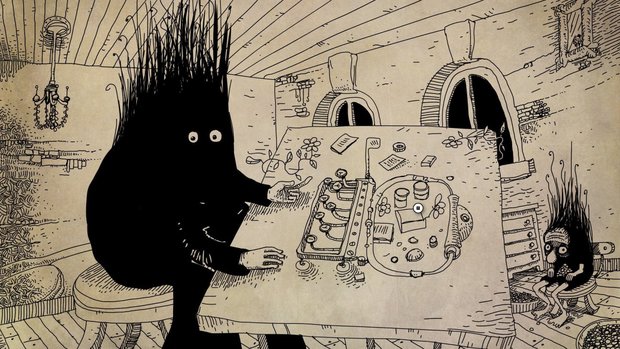
The first thing you’re liable to notice is the absence of color. Nearly everything on-screen is either black or beige, with grabbable items appearing in white to distinguish them from the backgrounds. (There’s a hard mode that turns this setting off; it otherwise plays identically.) The effect, in concert with the deliberate sketch-like character of Skutnik’s pen-and-ink illustrations, is of having fallen into the pages of some forgotten Edwardian fantasy tome. This is our world as glimpsed in the moments between waking and sleeping, or reflected just over one’s shoulder in a warped and foggy mirror. There’s an Alice in Wonderland quality to your wanderings, with bizarre creatures and surreal situations materializing in full and sudden flower without warning, context, or attempt to justify them: birds talk; fishermen cast their lines into empty air; paintings invite you to enter and walk around.
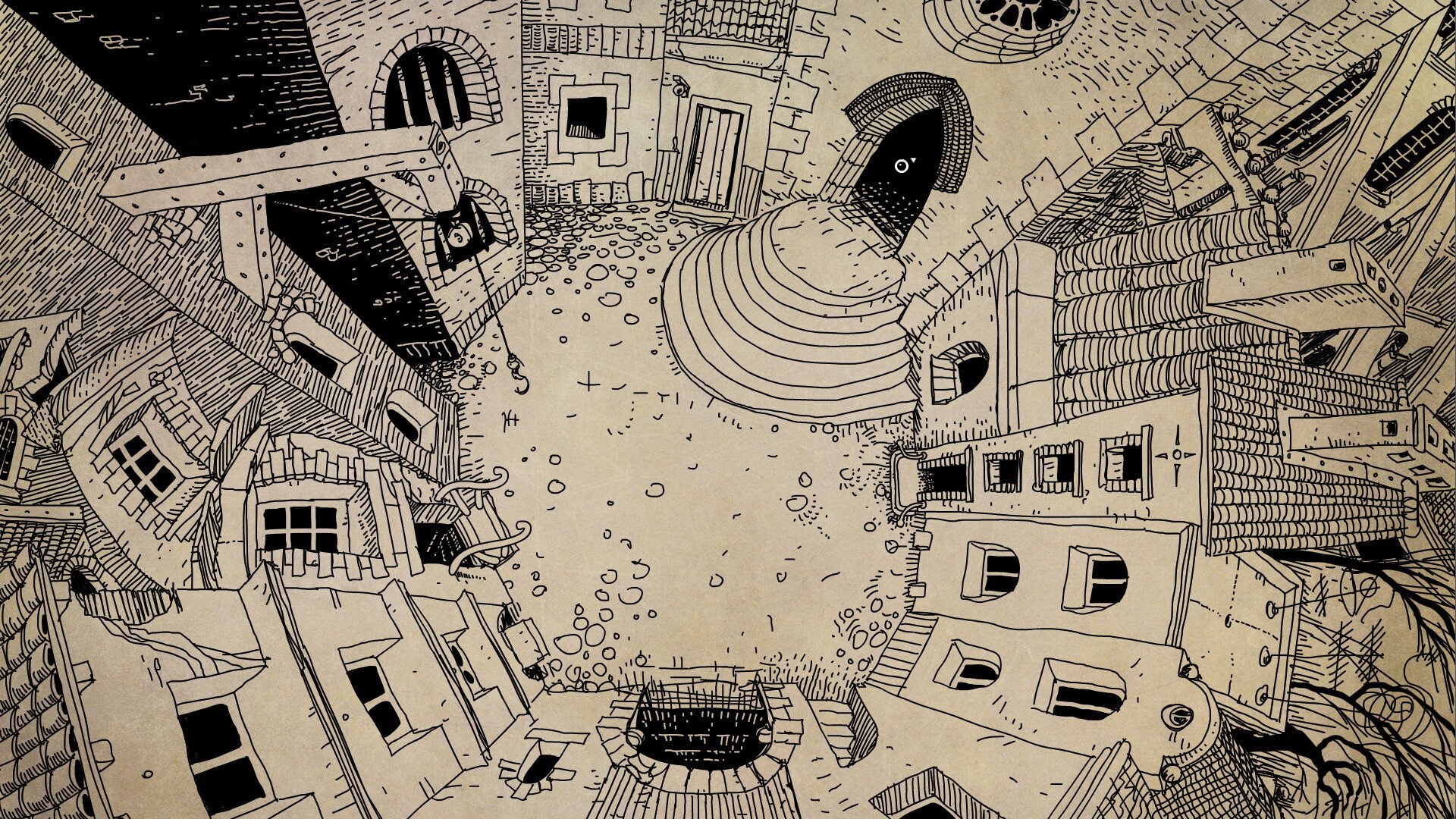
Some of the town’s inhabitants are recognizably human, but many aren’t. Hairy, large-eyed critters abound, huddling in nooks and alcoves or lingering alone or in pairs behind closed doors. Others appear variously reptilian, mammalian or even plant-like. (You’ll recognize one group of neighbors immediately if you’ve played Skutnik’s Slice of Sea.) There are whispers of giants and dragons lurking somewhere in the mist, and of stranger things than those. The imagery exists somewhere at the intersection of Mervyn Peake’s sketches, James Thurber’s cartoons, and the charcoal drawings of Odilon Redon, with messy, unruly silhouettes rendered nonetheless comprehensible by Skutnik’s meticulous precision in line and point. As befits the material, what we see seems always to have materialized from within a thickening fog. From start to finish, it’s never anything short of breathtaking to look at.
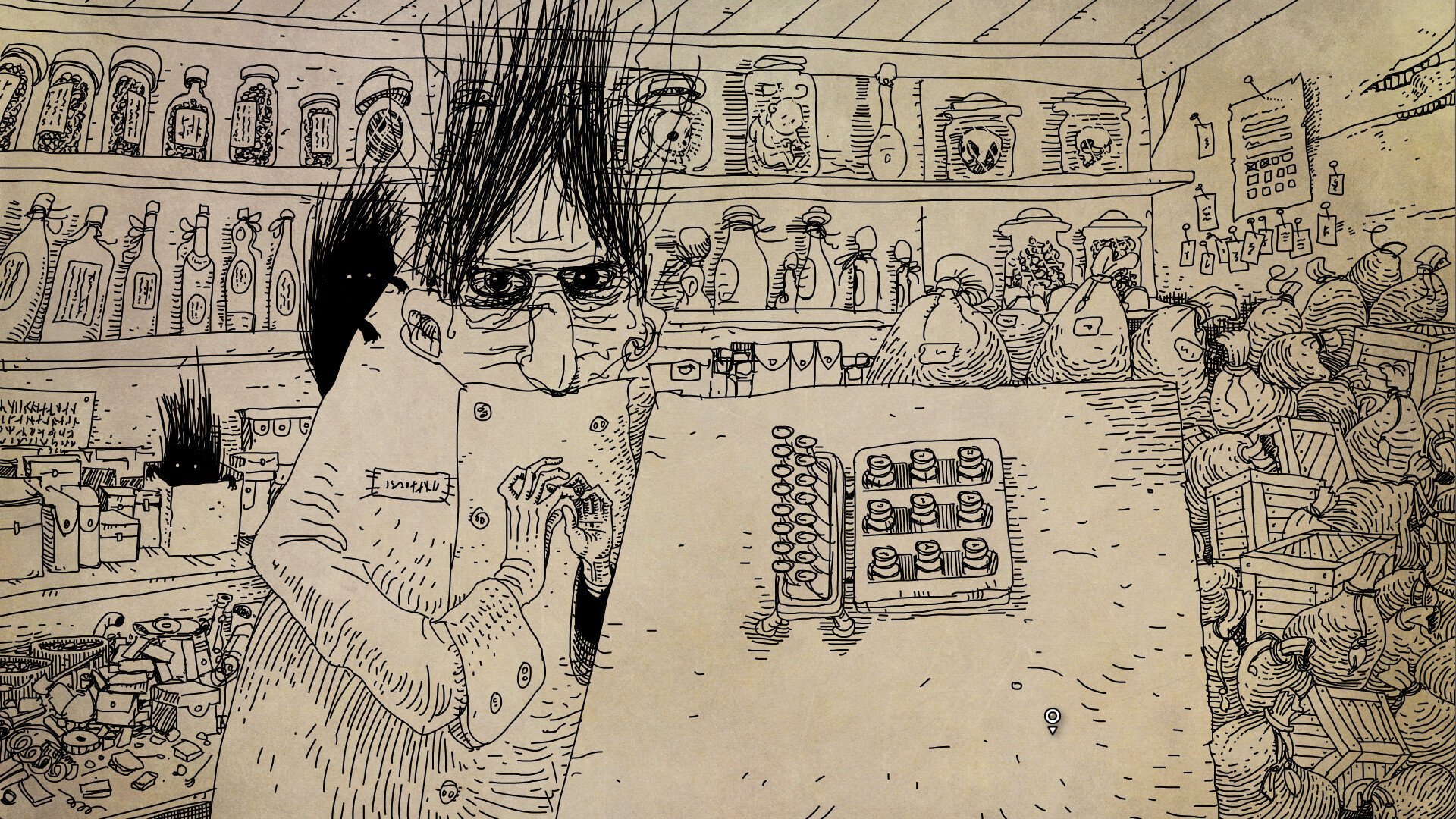
The fog, of course, is one of the main topics of discussion for those still in town, and you’ll hear many rumors about it in your travels—that it leaves nothing but empty space in its wake; that it claimed another two houses yesterday; that there’s nowhere left to escape to. There are no clear answers, only guesses and snatches of uncertain hearsay; society in town hasn’t quite broken all the way down, but it’s circling the drain, and those who remain have lost the will to work together in charting a way forward. Certain institutions keep operating—the Museum of Modern Art still charges admission, and St. George’s Hospital ministers to patients even while doing a lively trade in illicit drug sales—but others, like a grisly meat market or a tumbledown library, have been left to the scavengers.
The town’s decrepitude means guideposts are few and far between. Some characters will engage you in conversation, at which point a simple menu lets you select responses until they run out, but most people only deliver a single line of dialogue when you click or hover over them. Their speech tends toward the indirect and allusive, as do the various signs and graffiti scattered about. You’ll often have to speak to several characters to get a clear picture of your next goal or destination. Other times the game leaves it entirely up to you to keep going until you run up against an obstacle and deduce that it’s what you should focus on.
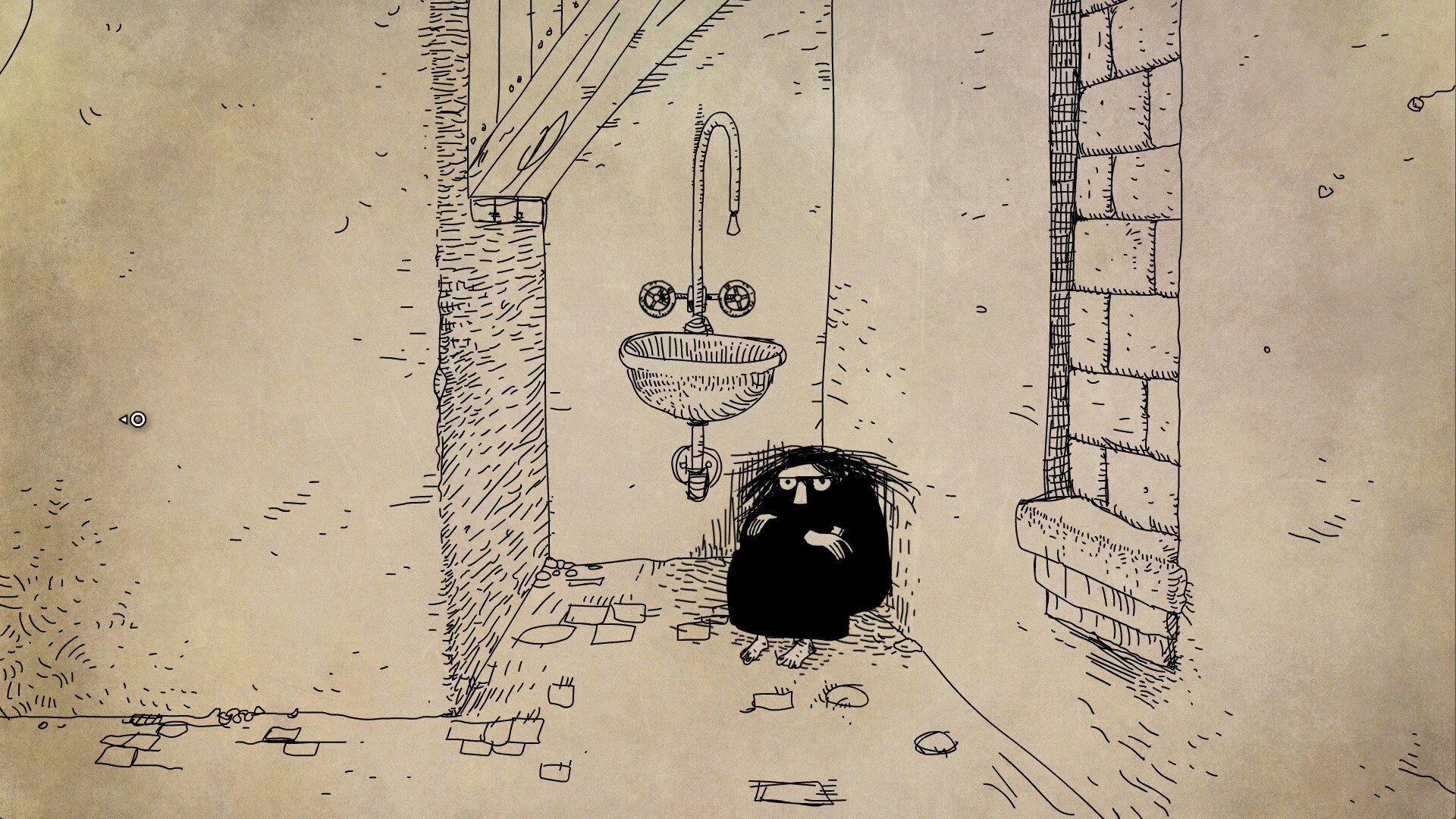
The more you explore, the more you’ll learn about the town, its inhabitants, and their efforts to either escape the fog or accept it. As oblique as the execution is, there’s a definite story to follow from beginning to end. You’ll learn next to nothing about your own character’s history beyond his desire to leave town, but he emerges in conversations as a curious if somewhat withdrawn observer of his world, living lightly while treating others with a tired sort of compassion. How the locals respond to him will teach you as much as what they say: some are lost and frightened; others relish company of any kind; many carry on in a resigned, weary state between denial and acceptance. The thought of such a fate seems to impel your character to seek an exit as much as the oncoming fog does.
Movement is node-based, with a context-sensitive cursor that points in the direction you’ll exit. A hand cursor indicates an item to be picked up, while a magnifying glass takes you in for a closer look at something. An indicator appears over hotspots where you can use an item from your inventory, which you access by right-clicking and selecting an object to drag into the environment. There are also many “invisible” hotspots, where secret optional actions are possible if you experiment with what you have (say, by using that hammer you found on a fragile-looking vase).
Daymare Town

| Genre: | Science Fiction |
|---|---|
| Presentation: | Slideshow |
| Theme: | Escape, Surreal |
| Perspective: | First-Person |
| Graphic Style: | Stylized |
| Gameplay: | Puzzle, Exploration |
| Control: | Point-and-click |
| Game Length: | Medium (5-10 hours) |
| Difficulty: | High |
On top of this, there are various collectibles scattered throughout each of the four chapters for you to hunt down if the mood strikes, along with optional arcade minigames you can access through cabinets hidden around town. These explain their controls and objectives upfront, and they’re mostly fun and simple diversions—a fog-themed Space Invaders clone, for instance, or a game where you avoid incoming birds as you fly a kite—but there’s also a surprisingly elaborate puzzle-platformer that could be classed as a mini-adventure in its own right, which unlocks a fantastic musical track by singer Cat Jahnke.
While your tasks tend to be straightforward—taking missing objects back to where they belong, collecting puzzle pieces to open locks, finding something to trade a character whose item you need—the challenge often lies in just identifying and tracking down what you’re actually looking for. I’d estimate there are more than a thousand screens to cover, each one chock full of elaborate visual detail with no color to break it up. Even in relatively uncluttered rooms, I sometimes overlooked what turned out to be important details. Still, this sets up a number of immensely satisfying a-ha! moments in which you’ll suddenly recognize, at long last, the one element missing from a puzzle that’s nagged at you for hours.
Everywhere you look, there’s more to see and do; it’s almost never boring, but next steps are rarely obvious. The first screen alone has eleven exits, and only some of them are apparent right away. There are many, many transition points throughout the game that you’ll only discover by carefully moving your cursor and paying attention to where it points. The same is true of hotspots, which may not distinguish themselves from other background elements. Skutnik’s art is painstakingly detailed, but it’s hard to tell at a glance what’s there because you need it and what’s just a part of the picture.
All of this is in keeping with the game’s intentions. The focus is as much on experiencing the environment to the fullest and moving on once you’ve had your fill as it is on making tangible progress. In its storytelling, puzzle solving, and exploration, the game’s watchword seems to be delayed gratification. It’s especially apparent in the sheer amount of surprises and hidden interactions secreted about the place for you to discover; they’re never necessary to progress, but they reward experimentation and encourage you to adopt a playful “I wonder what happens if…” attitude.
That said, the game world you’ll traverse across the four combined episodes is huge, and when you factor in all the secrets concealed beneath the surface, there’s actually more of it than it initially seems. If you don’t like retracing your steps while pondering the small details you might have missed, Daymare Town will probably drive you bonkers. There’s a world map, but it’s not very detailed, and while a system of portals lets you warp from one region to another, you have to find and activate each one, with several tucked away in unassuming crevices that you might not notice at first glance. Here even the fast-travel system requires time and patience to use properly.
Even if you love what the game is doing, there’s just so much of it that at a certain point it starts to feel exhausting. The environments are beautiful, but when you’ve spent roughly eight hours traversing hundreds of cluttered, colorless slides, things have a way of blending together in your memory. Considering how easy it already is to overlook inconspicuous but crucial screen exits, this can turn navigation from a challenge into a nightmare. I very much wanted to see more of the game’s unique world, but I found myself longing for a bit less space to see it in.
Still, in a game about searching for an exit that might not exist, the sensation of bewildered overwhelm feels not only appropriate but intentional. Every choice—the monochrome visuals, the ominous atmosphere, the mournful, desolate piano score—feels deliberately calculated to inspire those very feelings. Of course, when you’re wandering in circles without a clue where to go next, it might not make much difference to know that it’s on purpose. If that means Daymare Town occasionally feels like a victim of its own success, though, then “success” is still very much the operative word.
Final Verdict
Daymare Town isn’t a game you play to unwind, or that you can spend a casual half-hour with while waiting for the oven to beep. It’s deep, dark, dense, and daunting; even if you enjoy dancing to its tune, it might tire you out after a while. All the same, it’s hard to pull yourself away once you’ve started exploring its many nooks and crannies. The tantalizingly bizarre world is so captivating—with its chaotically beautiful artwork; its subtle, mysterious narrative; and its wealth of secrets waiting to be discovered—that even when you aren’t sure what to do, you’re glad for the chance to find out.
Hot take
If you can get on its distinctively weird, oppressive wavelength and stay there, you’ll find Mateusz Skutnik’s Daymare Town second to none in terms of atmosphere, aesthetics, and ability to keep you clicking just to find out what the impossibly imaginative setting will show you next.
Pros
- Beautifully strange and compelling visual aesthetic
- Art, music, and gameplay unite to create an atmosphere of mingled wonder, intrigue, and lonesome foreboding
- Packed full of things to do, see, and figure out, including secrets and optional challenges galore
- Rewards for patient exploration are incredibly gratifying
Cons
- So big and busy, with so little signposting, that it’s easy to get lost, overwhelmed, and/or exhausted
- Requires so MUCH patience that it can easily become frustrating
Will played Daymare Town on PC using a review code provided by the game's publisher.






0 Comments
Want to join the discussion? Leave a comment as guest, sign in or register in our forums.
Leave a comment