
Murder at the Birch Tree Theater review
- 0 Comments

Twenty years of musical theater whodunits should score high with fans of deduction mysteries
“All the world’s a stage, and all the men and women merely players…”
Shakespeare meant that figuratively, but it’s literally true in Crucible Juice Games’ Murder at the Birch Tree Theater, as long as you’re willing to consider an entire menagerie of anthropomorphic animals “men and women.” While a humble community theater might seem like an unlikely place to host high drama behind the curtain, it turns out that stage life can be deadly serious – even worth killing for. More than just a simple whodunit, this game goes far beyond a mystery that needs solving. Instead we get to know a group of thespians over the course of two decades, watch relationships form and break apart, and see them pursue their dreams by any means necessary. And yes, we do solve a few murders along the way through Golden Idol-style deduction that will seem very familiar in its mechanics. Despite a somewhat understated presentation, there’s just enough good-natured theatrical flair and charm to smooth out any opening-night jitters.
This is the saga of one Mason Wilder, a moose with a wild desire to see his name immortalized in lights at the eponymous community theater. The game opens in 1995, putting the cart before the horse in a brief tutorial chapter that teaches us the ropes while exposing us to our first murder: Wilder, a prominent figure at the venue, has been killed backstage in a dressing room during the opening night performance of a new musical! But you won’t get the full story on this just yet. After making a couple of quick deductions to close out the intro, you exeunt stage left and are whisked back in time to 1975 when Mason was nothing but an aspiring hopeful. From here an intriguing plot unfolds – of ambition, deceit, and clandestine machinations (and of course, plenty of murder) – spanning twenty years and ten stage productions before coming full circle by bringing you back to the beginning.
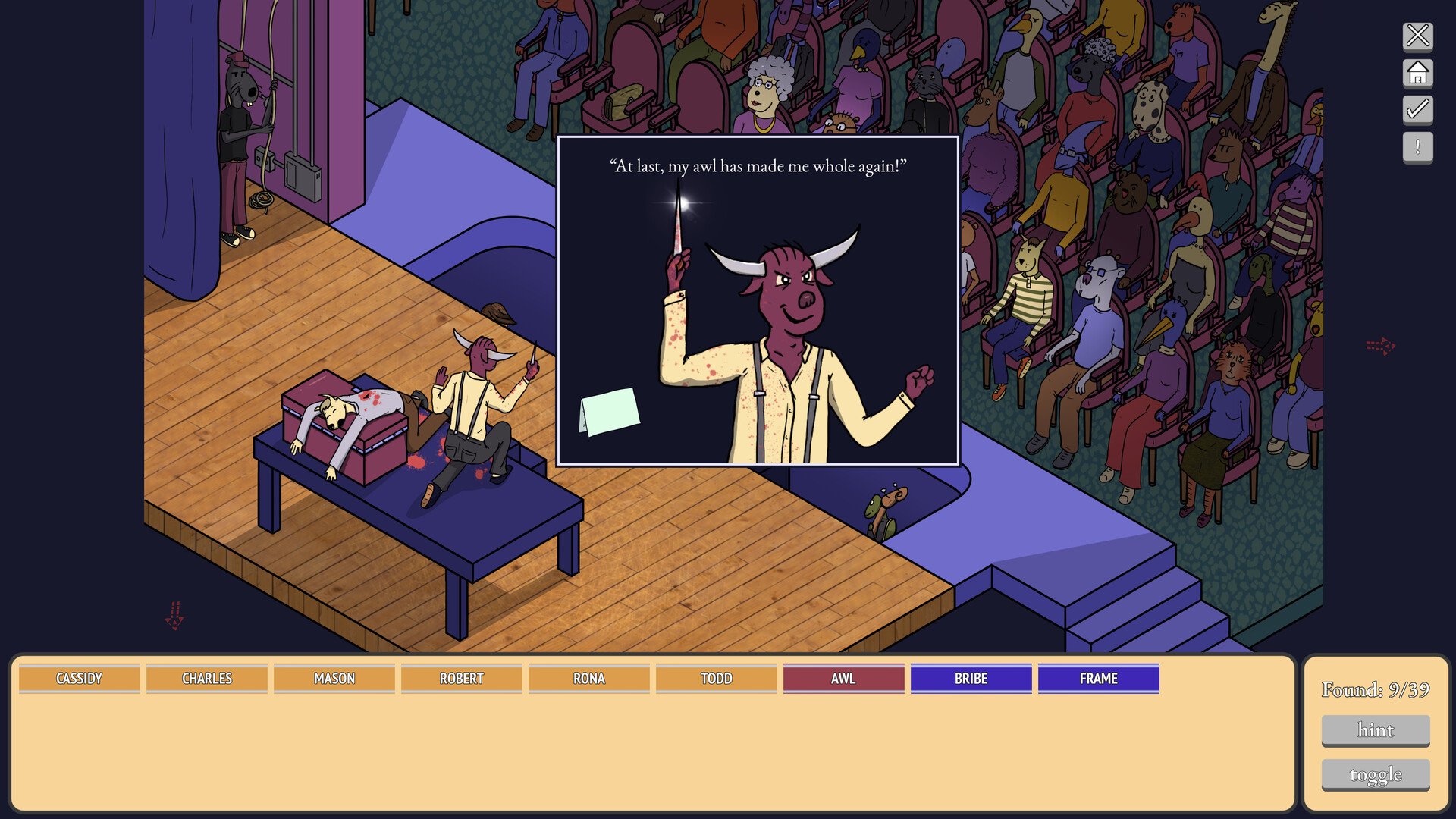
Along the way, the cast slowly but surely expands – and subtracts with each new victim. While it isn’t quite an ensemble (most characters don’t feel fleshed-out enough for that), there’s a definite sense that this isn’t just the Mason Wilder Show after all. It helps that quite a few faces become regulars who tend to stick around for multiple chapters, tied to the Birch Tree Theater in some capacity or another. Take Cassidy Hilliard, for instance, initially just a feline cast member who later leaves the small-town lights behind and breaks out into a lucrative career as a successful Broadway composer. There’s also Todd Chris, resident weasel with a suitably shady personality who serves as the venue’s props master, and you’ll spend some time getting acquainted with various members of the theater’s ever-changing board of directors, which figures prominently in many of the cases over the years.
And yet, with so many pieces in play, the game doesn’t follow a narrative in the traditional sense of the word. Each of the nine chapters is essentially a frozen moment in time based around a particular new play. These snapshots are taken immediately after a murder has occurred, with all nearby characters immobile, like statues caught in whatever act they were performing at the time, allowing you to conduct your investigation at your own pace while the evidence is still fresh and undisturbed.
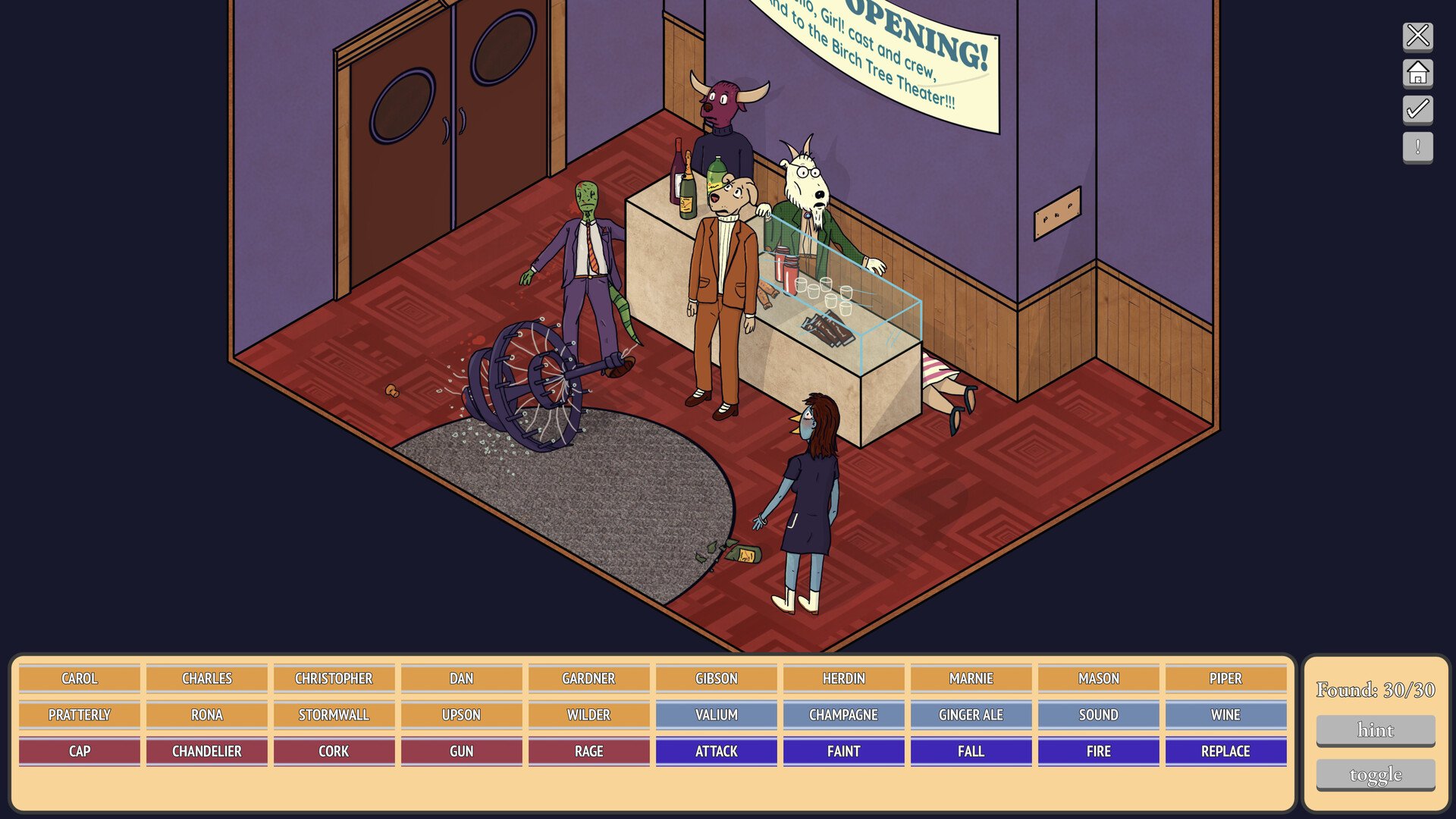
As has become custom for deduction games, each chapter presents you with a fill-in-the-blank description of the crime. Your job is to decode what happened, gather intel, and correctly fill in all blank spaces. Collecting the necessary information to complete this text puzzle requires examining characters and objects, going through their pockets and purses in close-up, and reading notes, letters, posters, and flyers left behind and strewn about the premises. Clicking on color-coded key words and phrases during this process adds them to your inventory made up of vocabulary terms rather than items. The exact number of clues to find is displayed on-screen for each case, and it’s these words and phrases, along with your deductive reasoning ability, which you must then use to complete that chapter’s word puzzle and lay bare the truth behind its murder.
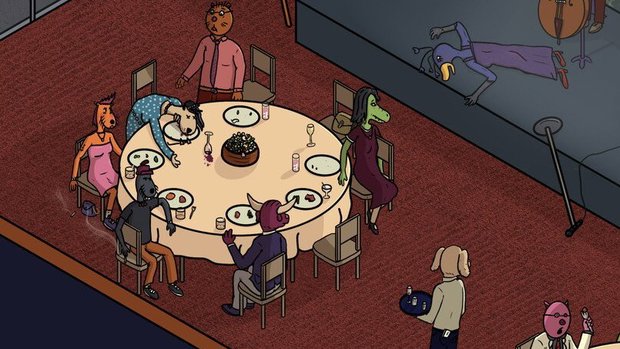
Each chapter also tasks you with a further unique deduction task, though they’re completed in precisely the same way as the murder investigations. For example, one chapter may ask you to properly identify all the members of a dinner party based on their seating arrangement around a large table, while another requires sussing out who’s who during an on-stage performance, matching names with props and costumes. Often the deduction tasks intertwine, with vocabulary terms potentially being needed in multiple solutions, while a few red herrings are sprinkled into the mix and are never used at all. For good measure and a bit of variety, two or three code-based puzzles are also included, such as needing a numeric code to unlock a door or opening the combination lock on a diary to get at its contents.
Murder at the Birch Tree Theater
| Genre: | Mystery |
|---|---|
| Presentation: | 2D or 2.5D, Slideshow, Isometric/Overhead |
| Theme: | Musical, Animal, Whodunit |
| Perspective: | First-Person |
| Gameplay: | Investigative, Deduction |
| Control: | Point-and-click |
| Graphic Style: | Cartoon |
As the game proceeds, the cases get more convoluted, with later chapters often featuring more locations, characters, and terms to collect. The final mystery is appropriately quite a challenge, featuring a veritable wall of text broken up by scores upon scores of holes that, I admit, forced me into guessing once or twice. (A solution only counts once it is fully completed, with no feedback on what errors you’ve made or even how many blunders you made.) To that point, though, the challenge had been firm but quite fair throughout, allowing for an enjoyable pace that should see most players finish in one or two puzzle-filled evenings, maybe around five or six hours in total.
As you progress in linear fashion through the cases, years pass by between them off-screen in the blink of an eye. Life goes on, people live their lives, careers are made and ended, and the little Birch Tree Theater continues to host new plays and musicals (and murders). To keep you abreast of what’s happened en route to the next enigmatic death, the chapter select screen provides additional background narrative in the form of letters, interviews, and publications to read up on, making sure you’ve bridged the gap to your next case with all relevant plot points filled in. This helps connect the disparate time capsules into a far more cohesive whole, which is important since you never actually experience any characters talking or interacting during the gameplay segments.
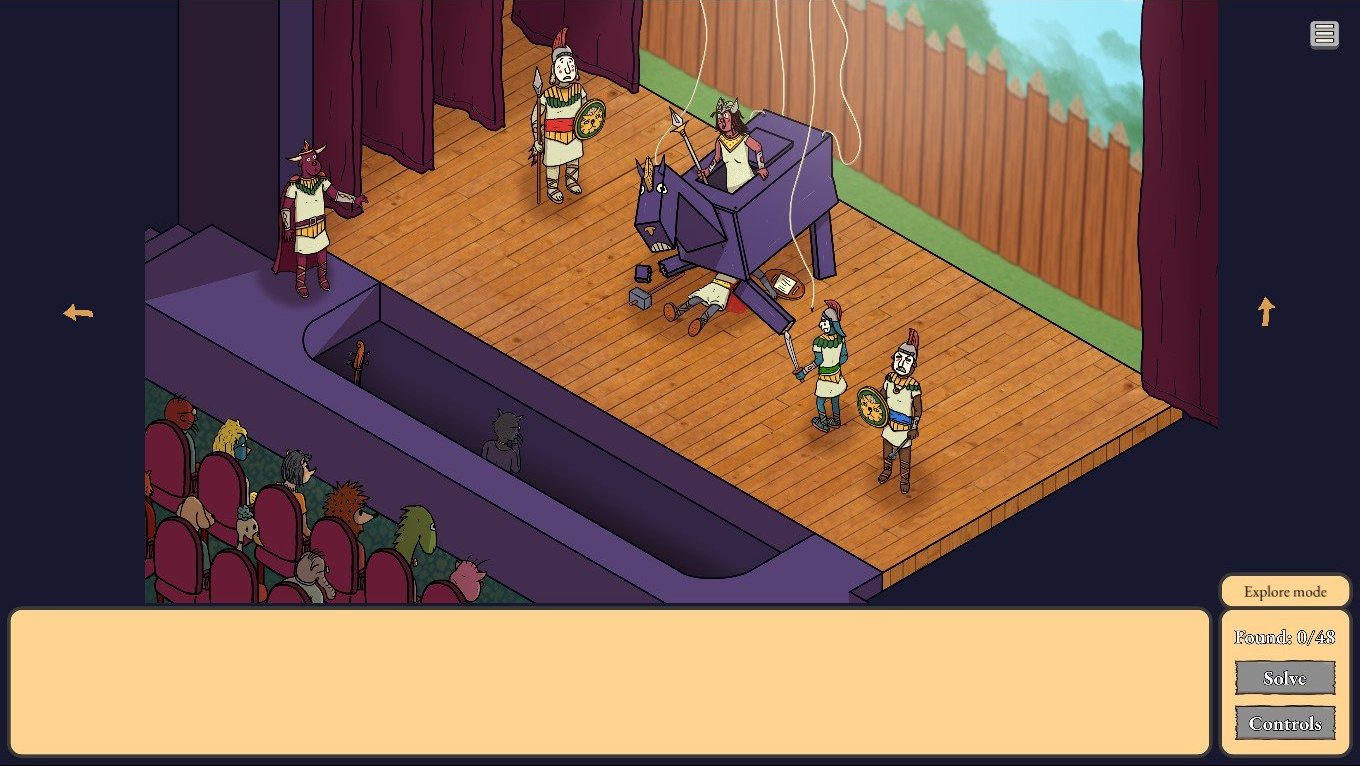
In terms of presentation, Murder at the Birch Tree Theater features a rather simple hand-drawn graphical style. Each scene is akin to a shoebox diorama, presented from an isometric perspective with all characters locked in place. I found the art style to be somewhat reminiscent of a Nickelodeon or Cartoon Network production – serviceable without being outright pretty. Here the action is entirely static, however, with cutaway close-ups to emphasize specific reactions or important moments.
Mechanically, gathering clues is as simple as pointing and clicking the mouse cursor at highlighted hotspots, while the bottom fourth of the screen consists of an inventory window that slowly but surely fills up with various names, nouns, and verbs as you play. As cases grow somewhat more convoluted, they’ll also feature more locations to comb through, with on-screen arrows allowing you to shift from on-stage to backstage, move down into the orchestra pit, jump to the theater lobby, or even climb up into the rigging or to the theater’s rooftop.
One thing I really appreciated – which, given the game’s themes and much of the accompanying subject matter, was pretty important to get right – is how much fun the designers had with the many theatrical references. The Birch Tree is much more than just an arbitrary setting for a game about a series of mysterious deaths. You can tell there is a love for musical theater baked right into the game’s DNA.
Each of the ten cases takes its influence from a real-world Broadway hit, and the chapter select screen is an array of the productions’ window cards, featuring altered mock-ups based on their actual counterparts. Theater nerds in the audience will be tickled to find many of their favorites paid homage here, from Les Mis to Chicago to Little Shop of Horrors – I smiled from ear to ear when my all-time favorite Sweeney Todd received its very own dedicated chapter. Better yet, although there is very little spoken dialog and no sung musical performances, the accompanying score for each case is often clearly based on the musical stylings of its inspiration.
Final Verdict
While Murder at the Birch Tree Theater doesn’t do much with its gameplay to stand out from the ever-expanding deduction mystery crowd, there truly is no business like show business, and fans of musical theater will surely appreciate its many nods to real-life Broadway hits. The individual cases are relatively short, each one potentially only taking around half an hour, though the latter ones do stretch this a bit longer. However, the connective tissue tying the whole experience together provides a bit more substance to the two-decade-long narrative of this little theater and the people who love it (but perhaps not so much each other). It rarely dazzles but it’s cute and manages to tickle the brain without being overly difficult, ensuring a handful of fun-filled, puzzle-solving hours of sleuthing.
Hot take
Come for the musical theater, stay for the mysterious deaths: Murder at the Birch Tree Theater raises the curtain on a fairly conventional but endearing series of decades-spanning fill-in-the-blank deductive cases.
Pros
- Intriguing murder plots to untangle
- Lots of love shown to real-world Broadway influences
- Each case offers additional mysteries to solve
- Passage of time elevates the story with an evolving ensemble
Cons
- Cartoony art style lacks standout qualities
- More memorable for its thematic stylings than its gameplay
- Complex final case may require a bit of guesswork
Pascal played Murder at the Birch Tree Theater on PC using a review code provided by the game's publisher.

- Advertisement
- Help support AGH by advertising with us








0 Comments
Want to join the discussion? Leave a comment as guest, sign in or register in our forums.
Leave a comment