
Confidential Killings review
- 2 Comments

No secret to the success of this solid new addition to the deduction mystery subgenre, 1970s Hollywood style
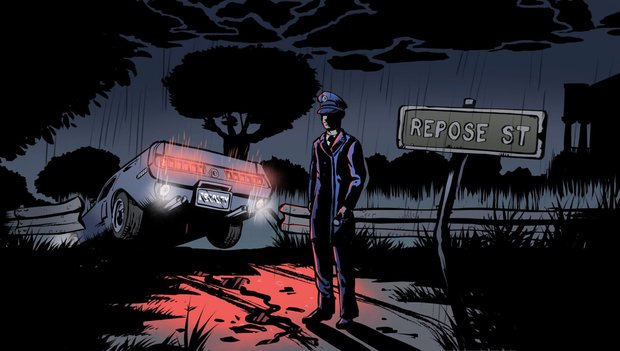
1970s. Hollywood, California. A call comes through: single car crash off the road, one casualty, uniform already on the scene. Looks routine – drunk driver veering off the road and into a tree – but all is not what it seems. Signs of sabotage litter the scene, and then there’s the issue of the victim’s family. Typical Hollywood nouveau-riche, but more and more murders keep popping up with ties back to familiar names. There’s a conspiracy brewing, with Tinseltown’s cutthroat film industry at the heart of it, and it’s up to you to get to the bottom of it.
Confidential Killings is the latest offering in a line of investigative deduction mysteries styled after The Case of the Golden Idol that strives to evolve beyond the original, now-classic formula. This game succeeds in doing so through the introduction of interrogations that integrate well with the core gameplay, though as a whole it falls short of its inspirations through a lack of challenge and some storytelling inconsistency. The length is short (I managed to finish in just over two hours, and can’t really foresee an active player taking any longer than four to complete it), but this results in a tighter narrative that slowly begins with the sad, but routine death of a drunk driver, and gradually escalates into a wider ring of interconnected murders. It feels like you’re always a step behind the mastermind of the whole plan, as suspects become victims and you’re left with more unanswered questions.
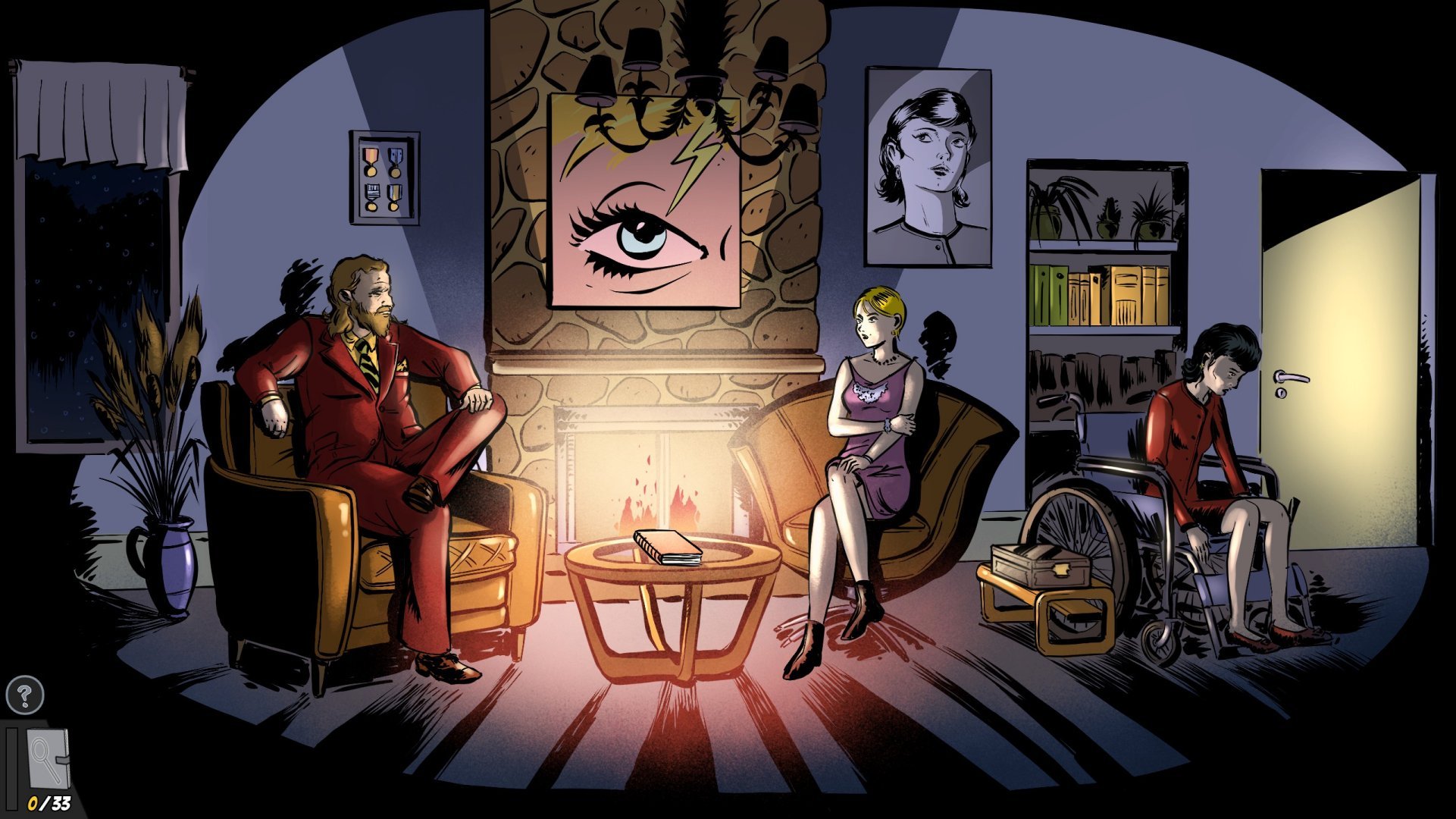
The story centers on a nameless detective within the LAPD unravelling a sinister conspiracy involving drugs, New Age religious organisations, and an increasingly suspicious cast of recurring characters. It’s a strong narrative, perhaps the best aspect of Confidential Killings. These characters play a large part here, in particular rising young actress Kady Keller, who is introduced in the second case and becomes a regular mainstay, though none of the film industry professionals around her can quite understand why she keeps getting offered big parts in productions. There’s a sense of one-sided frustration with Kady among the other female actors, and slowly bits and pieces are revealed about the strings being pulled behind closed doors to ensure she becomes a star.
I only have one small criticism when it comes to the story, and that is the small leaps of logic required to follow along. Most of the time, people will react to you as though you are interrogating them or asking them questions, which does a lot for immersion. However – and this is most obvious during the case at a hotel – there are moments in which information gained by you as the player would not be available to your character. The presentation switches between first-person and omniscient viewpoints during some of the more elaborate scenes in order to fully convey the various plot points and side stories. It’s a minor criticism, but when the game hinges on the strength of its story, it’s something that becomes more noticeable.
Confidential Killings – A Detective Game
| Genre: | Mystery |
|---|---|
| Presentation: | 2D or 2.5D, Slideshow |
| Theme: | Noir, Whodunit |
| Perspective: | First-Person |
| Graphic Style: | Illustrated realism |
| Gameplay: | Investigative, Deduction |
| Control: | Point-and-click |
| Game Length: | Short (1-5 hours) |
| Difficulty: | Low |
The interface is what can be expected for an investigative game, with a left-click of the mouse being the sole form of control. Gameplay is in the vein of a traditional deduction game, clicking on relevant characters and objects found within environmental slideshow displays (or subsequent close-ups). The total number of clues to find in each scene is shown in the bottom left corner, and hotspots highlight when you hover the cursor over them. Once selected, you’ll then pull out any underlined words within their dialogue or item descriptions to build up a word bank for a text reconstruction. You’ll use these clues to fill in the missing blanks in order to identify everyone at the scene and the series of events, conveniently color-coded to separate characters, verbs, and nouns.
A journal for notetaking is provided from the deduction screen, which came in especially handy for a case in which the expanding cast of characters was split across multiple rooms and I needed to keep track of their possessions without constantly backtracking. Another quality-of-life feature is an optional hotspot highlighter indicating what objects you’ve yet to click on, though in my playthrough I found this marker didn’t save when I quit, and continued showing me hotspots I had already clicked on upon resuming the case. There’s a distinct lack of a hint system otherwise, though every case is fairly straightforward in terms of the who, with the why and how discernable via context clues gleaned from the dialogue of other characters and what items they’ve got on them if you’re paying attention.
A late case taking place within a spiritual facility involves finding a key on one of the characters, introducing a small inventory to the typical deductive gameplay. For the most part, however, there’s not much in the way of puzzles beyond the main objective of figuring out who killed the latest victim by investigating each suspect’s belongings and engaging them in conversation. The main challenge is in being attentive to the characters’ motivations and relationships with each other. The linearity of the narrative, broken down into nine distinct but related cases, leaves little room for further twists and turns within each case to potentially stump you.
Fortunately, the marriage between gameplay and narrative is one of the brightest spots of Confidential Killings, breaking up the cycle of first-hand investigation with dialogue sequences as the story progresses and more concrete suspects are zeroed in on. I really wish the developers leaned further into the interrogation aspect to help players get to know the recurring cast better and increase the feeling of being immersed in detective work. The screens in between each case are used effectively to further secondary plots happening in the background, with newspaper clippings and archived case files helping to flesh out the world and give a sense of time passing.
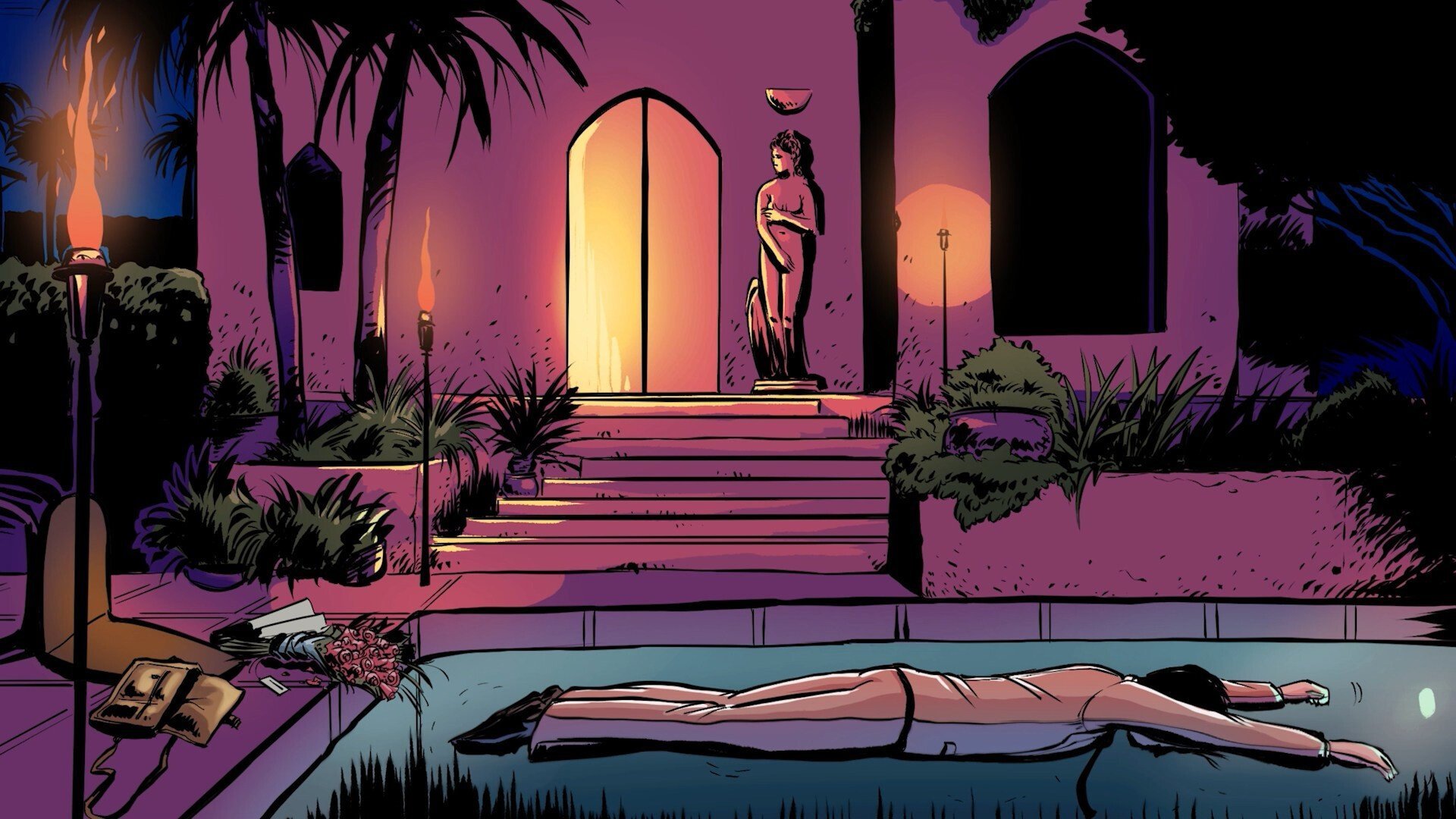
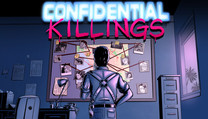
The graphics and sound do a lot of heavy lifting to tie the game together and make the story and setting more believable. From a radio station at which a seemingly accidental death due to faulty equipment occurred, to a disco club that’s almost certainly the front for a drug dealing operation, and culminating in the stark white headquarters of an organization that is definitely not an analogue to Scientology, each hand-drawn location evokes the aesthetic of pulpy comic books à la Dick Tracy, enhancing the atmosphere while also helping to ground the setting in the past. The usage of a period-appropriate colour scheme of burnt oranges and blues complements the retro setting, and various scenes nicely play with shadows and darkness, requiring a light switch to be turned on before the full scene is revealed in many cases.
The visuals are accompanied by an atmospheric but unobtrusive soundtrack that succeeds in escalating a feeling of dread and unease as the game progresses. While there’s no voice acting to further drive home the mounting creepiness with each subsequent case, the deep percussive drums feel like an ever-growing throbbing headache that ends only when reaching the final crime scene, in which mystical chanting of the Ad Astra spiritual group rings out in the closing scenes of the game. What I particularly appreciate about the soundtrack is the underlying motifs of synths, to really remind you that the game takes place in the 70s and maintain that level of immersion.
Final Verdict
With its stylish pulp comic design and volatile 1970s Tinseltown setting, Confidential Killings offers an intriguing backdrop for a series of murders. The suspect interrogations are a good idea that show the potential for investigative deduction games, but a sparse application of them has left room for improvement. The game’s short play time is a testament to the tightness of its story, but also reflects a lack of challenge that has left me wanting more as well. I enjoyed my time with the game while it lasted, however, and I look forward to seeing the developers build upon this solid foundation in future releases.
Hot take
Fun enough while it lasts, Confidential Killings gets in and out a bit too quickly with its tightly paced plot and lack of much challenge, all wrapped up in the glitz and glam of 1970s Hollywood.
Pros
- Cohesive story that slowly expands in scope across nine distinct cases
- Atmospheric music blends well with the pulp comic art style
- Interrogation segments are well-implemented to expand the traditional deduction gameplay formula
Cons
- Lack of challenge results in a short playtime
- Slight inconsistency with player perspective
- Interrogation sequences are under-utilised in a short game
Daniel played his own copy of Confidential Killings on PC.







2 Comments
Want to join the discussion? Leave a comment as guest, sign in or register in our forums.
Good review, Daniel! Surprised to see it's such a short game. The reason I didn't jump on it myself is because I thought it would be too lenghty... Now I might still give it a try.
Reply
I’ve got similar feelings. I like the setting and presentation. The length is fine, but it could use to be a tad more challenging. The idea of doing the Idol formula but with player “controlling” an actual character is nice, but ultimately doesn’t change all that much. It’s a fine game, I had a good time. But it falls short of its inspiration.
Reply
Leave a comment