
Run TavernQuest review
- 0 Comments

Bold and brilliant twist on the traditional text adventure is brimming with funny touches and only gets better with age
I am old enough to remember text adventures when they were at their height, before the introduction of graphics to the genre. It was a thrill reading verbose descriptions of rooms and trying to figure out how to solve puzzles by typing commands, resulting in either success or failure, or simply error messages when I did something unexpected. Run TavernQuest is this sort of experience, but with a brilliant, innovative twist to go with plenty of delightful humor and a streamlined interface. Instead of playing the game as yourself, here you are the game. The player is actually Steve, and you must help him navigate the perils and pitfalls of his adventure, all the while trying to save a princess from a nasty dragon in spite of Steve’s worst efforts. Simple enough, right? Well…
Let’s just say that Steve is less inclined to play interactive fiction in the same way we’re used to. While he does use standard commands like “leave tavern” or “climb tower,” he often uses nonsensical terms like “dude, just read the note” after several attempts to examine what’s in his inventory. The CPU, which acts as your guide throughout the game, will comment privately to such unintelligible phrasing, often sarcastically, and usually give you options for how to respond, right down to throwing up standard errors like “you can’t do that.” However, as the game program you can be smarter than that and try to interpret for the CPU what Steve is attempting to do.
Run TavernQuest may be a text adventure, but it plays out more like a “choose your own adventure” story (except in this case, more like choose someone else’s adventure). Steve is in control of the actions of Wendyll (the player character), but you control the other characters and decide how things play out. The CPU may ask for help in describing a room or where Wendyll goes next, and it’s up to you to decide if he goes into a tomb or a cave to start Act 2, for example. Other choices are less impactful, initially anyway. You can pick whether the dwarves in the tavern are either brawling or gambling and if the rats in the cellar can speak or not (yes, that is an option and the one I picked because it’s hilarious).
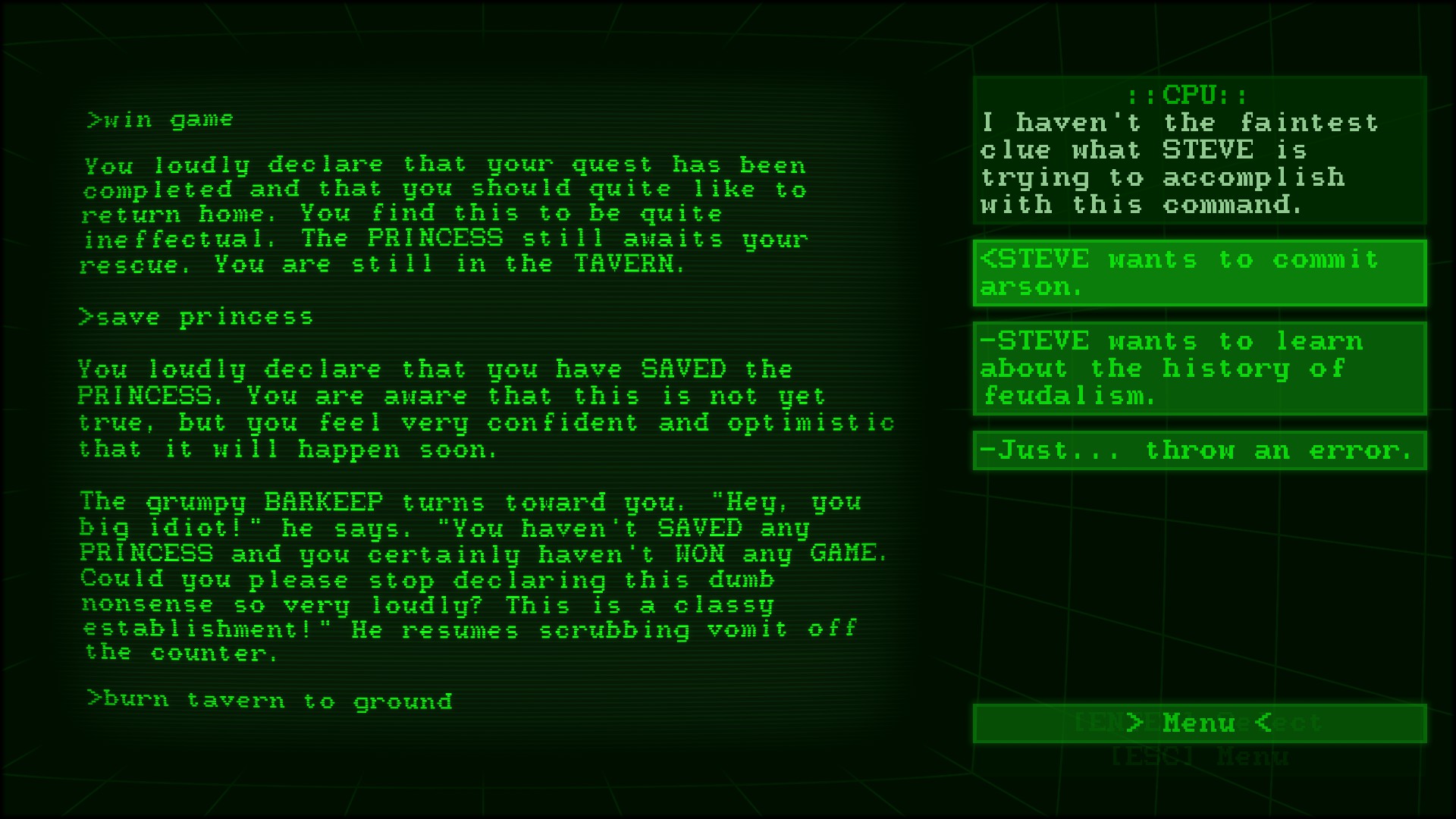
But here’s the thing: Steve plays like an idiot. It’s even alluded to several times throughout the game. You can even call him that and use failure messages like “Way to go, idiot” or “Nice going, moron.” Or, you can be more sympathetic to his plight and try to help guide him through with more tact. It’s up to you, but I’m pretty sure that whether using either kid gloves or snarky comments, it doesn’t amount to much influence on the story. I thought it was funnier to think of Steve as missing a few brain cells and treat him accordingly.
Humor is very much at the forefront of Run TavernQuest. From the moment Steve loads up the game, hilarity ensues. The CPU’s private, increasingly exasperated responses are often very amusing, and as the game itself, you’re allowed to put out some weird and wacky messages, and even present Steve with some very funny options. He will try things like pulling all three levers in one puzzle, for example, allowing you to afflict him with a curse from three options: he can only talk by shouting (my choice), he turns into a donkey, or he will go bald by the age of thirty. (And yes, he will use all caps to shout until, if he so chooses, to end said curse through an NPC later in the game.)
You’re free to create other comical scenarios with your choices as well. One early possibility lets you place a pack of hot dogs in the cellar of the tavern for no apparent reason. To nobody’s surprise, Steve picks it up. The hot dogs are obviously a red herring, but Steve doesn’t know that. And yet during my time in the tomb, I was tasked with giving him a couple puzzles, including pushing a lever to head further into the crypt. And guess what? Steve tried to shove a hot dog into the console. Why? Who knows what’s going on in his demented mind. These are just a couple of examples of the insanity that Steve puts himself and us through. Right up until near the end of the game, there’s plenty of humor to go around.
Run TavernQuest plays out in three parts: a tavern, either the tomb or a cave, and the finale up the mountain to the tower holding the captive princess. The game itself seems pretty short, which was common for text adventures, but it actually extends far beyond the initial rescue. After trying to save the princess the first time, the game ends and Steve logs off. However, some indeterminate time later you get what the achievements call “New Game+”. This is a second go-around as our intrepid hero finds himself back at the tavern. While I expected more of the same, this telling of the story goes quickly off the rails. As the CPU – and you as the game – try hard to get Steve back on track to the mountain, he instead leaves the tavern and wanders off into the countryside. This isn't as originally scripted, of course, so you have to come up with encounters and locations that weren’t part of your programming.
This is where things really start to get fun, because you’re flying by the proverbial seat of your pants the second time through. What quests do you offer Steve as you gently (or not so gently) nudge him back towards the princess and the dastardly dragon? I went with the tried-and-true option of having a chain-smoking farm lady give Wendyll the goal of acquiring ten bear pelts. After all, what’s a game without a fetch quest, and you never know just what might inspire Steve to get back on track. How this, or other options, plays out is both up to you and Steve. I once again chose to make the animals intelligent when given the chance, adding an interesting layer to the quest of our intrepid “hero” as he goes on a killing spree to get his vaunted skins.
Run TavernQuest
| Genre: | Fantasy |
|---|---|
| Presentation: | Text Only |
| Theme: | Rescue |
| Perspective: | First-Person |
| Gameplay: | Text adventure, Choices matter, Narrative |
| Control: | Point-and-click |
| Game Length: | Medium (5-10 hours) |
| Difficulty: | Low |
| Graphic Style: | Text |
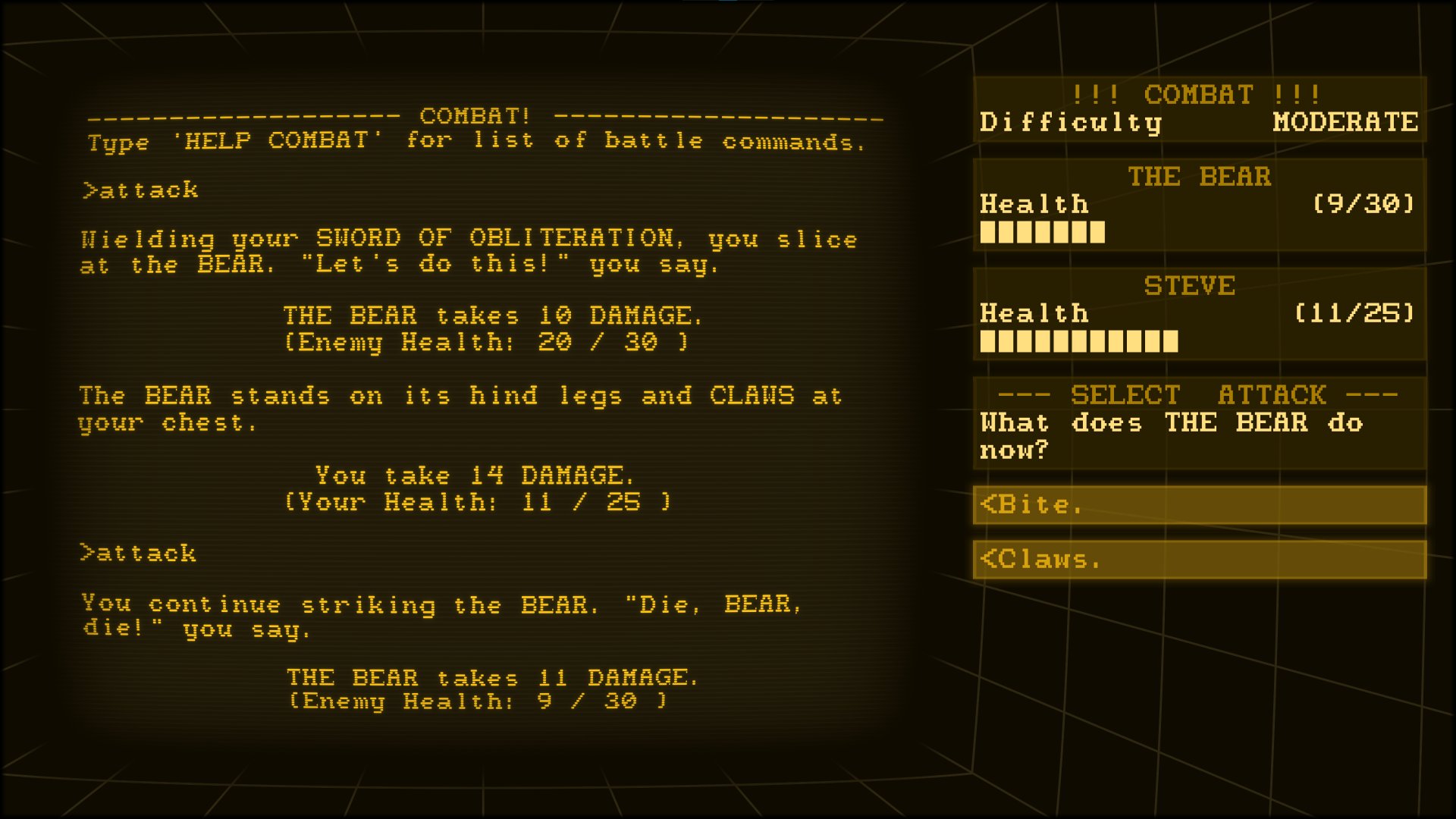
This brings me to another aspect of Run TavernQuest that makes it somewhat unusual compared to the text adventure heyday of the 1980s. In this case, the game allows combat. And Steve loves to attack things. Even the barkeep is not immune to his slaughtering ways, as Steve is eager to kill and loot the bodies of everyone in the tavern. (At least in the first playthrough.) But he is so unimaginative that the only command he uses throughout these battle scenes is “attack.” The CPU even remarks that there are many more ways to end an encounter but that Steve is, again, an idiot.
As the game itself, you decide what the enemy does in battle. You can go the standard route and just attack back, but some of the options are funny and don’t quite do what you’d expect upon first glance. Pick the “splash” option with the dwarves and they’ll throw their mugs of ale at Wendyll. It’s your job to keep our hero alive, so you must try to pick the options that do him the least damage. Or not, to see what happens – there is a game-over screen, but Steve can try as many times as he likes until he wins. Picking the least damaging options isn’t always easy to figure out. It can take some trial and error, but the amount of health depleted doesn’t really change that much for each option.
It’s not a spoiler to say that Steve / Wendyll does eventually get to the girl in the tower a second time. The dragon can be sleeping or eating when our not-so-gallant knight gets there, but the result is the same: Steve attacks said scaly beast instead of sneaking by. (Because why fix what isn’t broken, right?) What happens when he does depends on what kind of potion you get from the monk of Ela at the base of the mountain, and what options you pick as the dragon. I ended up having the dragon just give up and let Steve whittle down his health.
You’d think that might be the end, but there’s even more left to do. Run TavernQuest may play out as a typical text adventure game, with Steve being the incompetent and combat-hungry protagonist, but there’s a much deeper narrative being spun here. Especially once you get to the third, and final, playthrough, dubbed “New Game++” in the achievement list. This time around, both the princess and dragon are more than they appear at first glance. They may seem to be nothing but prisoner and guard, respectively, but after a while it becomes apparent that they’re a bit more than standard cookie-cutter NPCs. The game eventually evolves from an almost slapstick comedy game to a much more serious take on free will. I may have come for the humor, but it’s the existentialism that gripped me more than anything here.
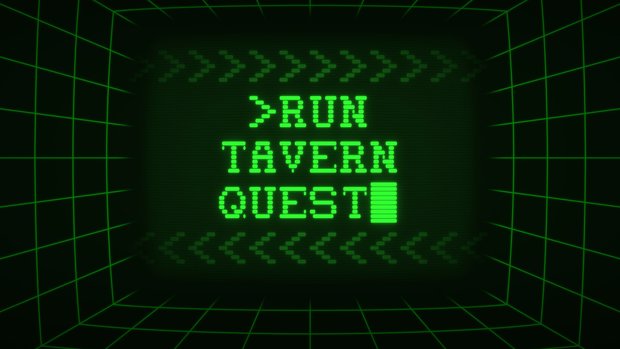
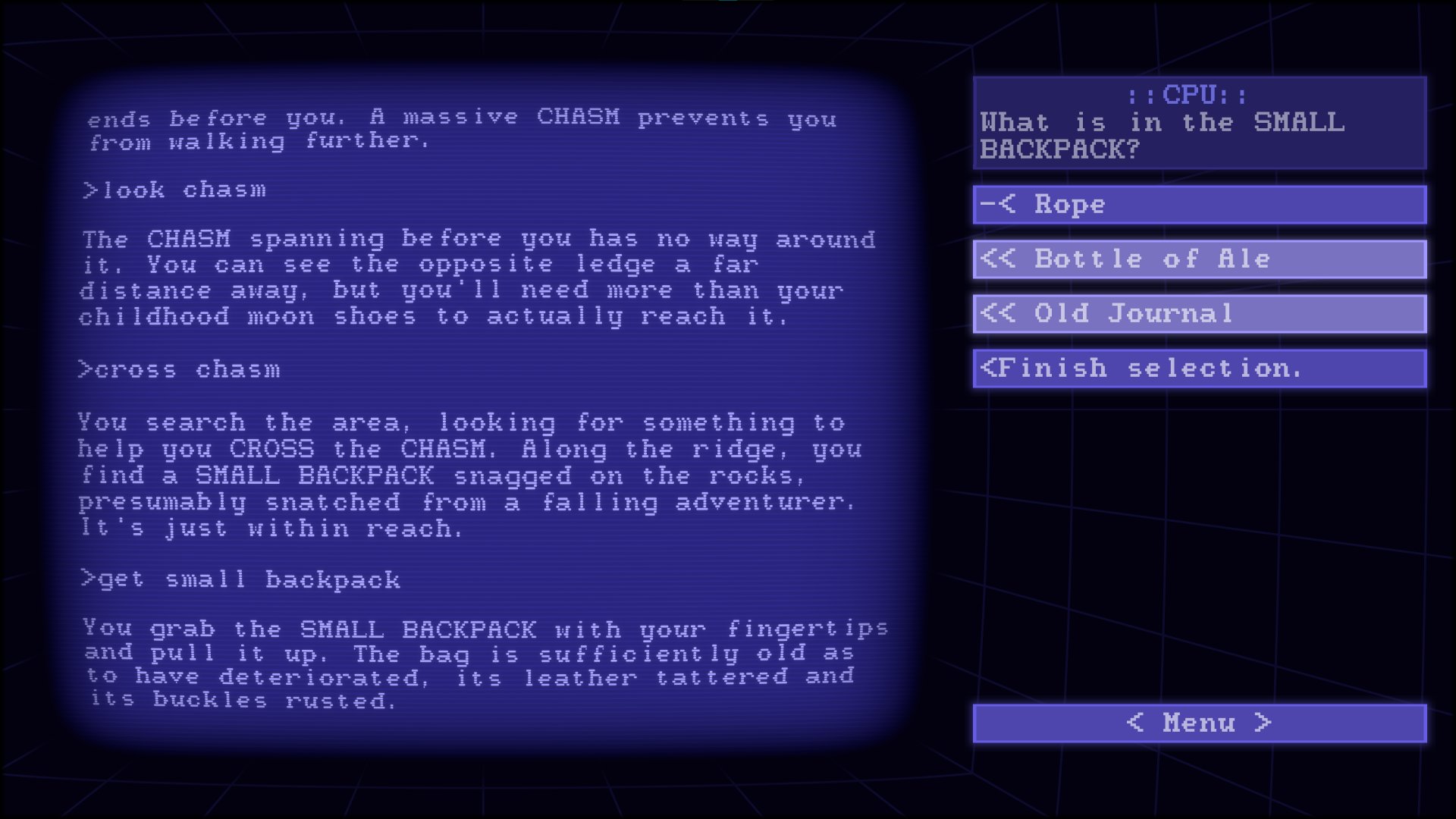
Being a text game, there isn’t really much to look at in Run TavernQuest, but at least said text is color-coded. The main text is either green, yellow, or blue depending upon which of three runs you’re playing through. In all of them, the left two-thirds of the screen is devoted to the CPU’s interaction with Steve, while the right third is for your own interactions with the CPU and choice selections for the dimwitted player.
Surprisingly for a text game, much of it is voiced by different actors. The narrator’s lines are always displayed in the default color but there are two other voices within the game that have their own visually distinct text. The princess speaks in a lavender “tone,” and the dragon in an angry red. The narrator is the equivalent of a dungeon master in tabletop RPGS, reading out the descriptions and providing the voices of Wendyll and all the NPCs in the game. The princess is, of course, more regal and feminine, and the dragon is a deep booming bass. Without spoiling much, both of these characters play out as if they were their own intelligences and separate from the narrator. Regardless of character, the text is very well read. It’s like a quality audiobook, and I really enjoyed listening to every word.
The game ends up being longer than one would expect from modern interactive fiction, taking me almost six hours to get through all three playthroughs. That said, the majority of the time I spent playing was just listening to the excellent voice work. You can turn off the audio and read for yourself as you would any novel or text adventure if you wish. And if the default text isn’t your thing, there are several font options to choose from in the menu. If you want to speed through the text itself, you can fast forward by holding down the left mouse button. But I don’t recommend doing this as the story as a whole is worth reading (or listening) through to the end.
Final Verdict
Run TavernQuest may be a text adventure where you select responses from a list of options instead of typing said commands yourself, but Steve’s own actions are what drive the experience. By cleverly removing you as the main character in this story, the game challenges you to nudge him in the direction of your choosing, often to highly amusing effect as you deal with his unavoidable idiocy and an incredulous CPU. You can play as snarkily or sincerely as you want in Steve’s quest to save a princess that might not want saving at all, from a dragon that might just be a bit more apathetic than you’d think a dragon would be, with three distinct playthroughs and plenty of replay value to go back and try other things. There are no real puzzles in the traditional text adventure sense, but even if you’re not interested in most “choose your own adventure” games, this one works on a level that is quite unexpected and is well worth checking out.
Hot take
Run TavernQuest smartly turns the text adventure conceit on its head with its choice-based selections and removal of players from the starring role to explore free will and existentialism with a comedic backdrop, leaving one contemplating what it means to be alive.
Pros
- Fully voiced with memorable characters
- Seemingly shallow story becomes much deeper with each playthrough
- Choices vary in impact but it’s often hilarious to experiment
- Lengthy runtime for interactive fiction, with additional replayability to boot
Cons
- Lack of any puzzles beyond choice-based combat
- Provides preset text responses to choose from instead of a text parser
Serena played her own copy of Run TavernQuest on PC.



0 Comments
Want to join the discussion? Leave a comment as guest, sign in or register in our forums.
Leave a comment