
Edgar Allan Poe’s Interactive Horror: 1995 Edition review
- 0 Comments

While it still has bugs that should have long been put to rest, a surreal cult classic reawakens evermore in this re-release of The Dark Eye
Deep into that darkness peering, long I stood there… taking in the impressive artistry on display in a game thought to be lost to time (at least, outside of tracking down a secondhand physical disc and the means to get it running). You wouldn’t know it from the name, but GMedia’s Edgar Allan Poe’s Interactive Horror: 1995 Edition is really just a re-release of The Dark Eye, the obscure yet beloved cult classic from long-defunct developer Inscape, made available digitally for the first time. That in itself is a minor miracle, and as someone who never experienced The Dark Eye before, I was curious about the concept of a stop-motion point-and-click adventure where you live out some of Poe’s most iconic stories from the inside. While the game boasts of being the same surreal horror experience as it was when it first released in 1995, rather than any kind of remake or remaster, that means some of the original’s failings remain, and some surprising issues are introduced with this version that slightly tarnish its nightmarish gleam.
Your role in Edgar Allan Poe’s Interac... (actually, let’s just call it The Dark Eye from here) is the unseen, nameless narrator, visiting your uncle Edwin at a remote manor in the late 1800s after receiving a letter from your brother Henry. Henry has asked you to meet him there in order to help convince your uncle that he should allow Henry to marry his daughter Elise (also your cousin, because, you know, 1800s). Edwin is a painter, and in his art he uses a peculiar paint thinner that causes some unfortunate side effects in those who are exposed to it without proper ventilation for too long. The manor must be afflicted with a lack of open windows, as you pass out at various points of the story and are transported to a nightmarish reflection of the estate, where interacting with certain objects (an empty bird cage, a bottle of wine, etc.) transports you into one of three of Poe’s twisted tales: “Berenice,” “The Cask of Amontillado,” and “The Tell-Tale Heart.”
These aren’t simply retellings of the stories as they were, however. In all three, you’ll take on the role of not just the killer, but also the victim in separate sequences that play out during one of the protagonist’s nightmares. Progression is achieved through completing a story in its entirety from either perspective. Each time you finish one, you will then return to the manor and play through the next section relating to Edwin, Elise, and Henry. The items you find in the manor aren’t labeled with any indication of which story you’re entering or from whose perspective, but the tales are the same in every playthrough (i.e. the cleaver always starts “The Tell-Tale Heart” from the killer’s perspective.) You can play through any of the Poe stories from either role in whatever order you wish, but the main plotline advances linearly in between. While this risks the experience feeling disjointed, the fact that you have to finish one before resuming back at the manor helps to keep the overall narrative feeling cohesive.
Controlling your characters is simple, with a one-click interface handling everything aside from the pause menu where you can save and load your progress at any time. You traverse static pre-rendered first-person backgrounds by moving your cursor to the sides of the screen and clicking either left, right, or up depending on what directional options are available. Your cursor is displayed as an animated hand that appears translucent when idle but will become opaque and change gestures depending on the type of hotspot you are mousing over. This includes a curved hand during sequences that can only be described as caressing something (you legitimately have to click and move the mouse in a rubbing motion here – it’s as unnerving as you would expect). There are rare occasions when you actually take an item to use in a specific scenario, but these are less for inventory puzzle solving and more for adding to the scene, such as one section that has you picking up a torch before heading down a dark catacomb.
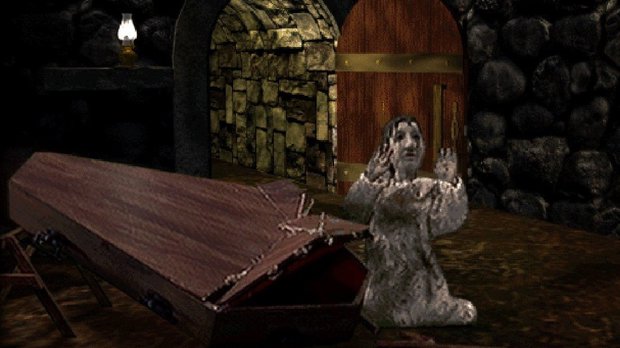
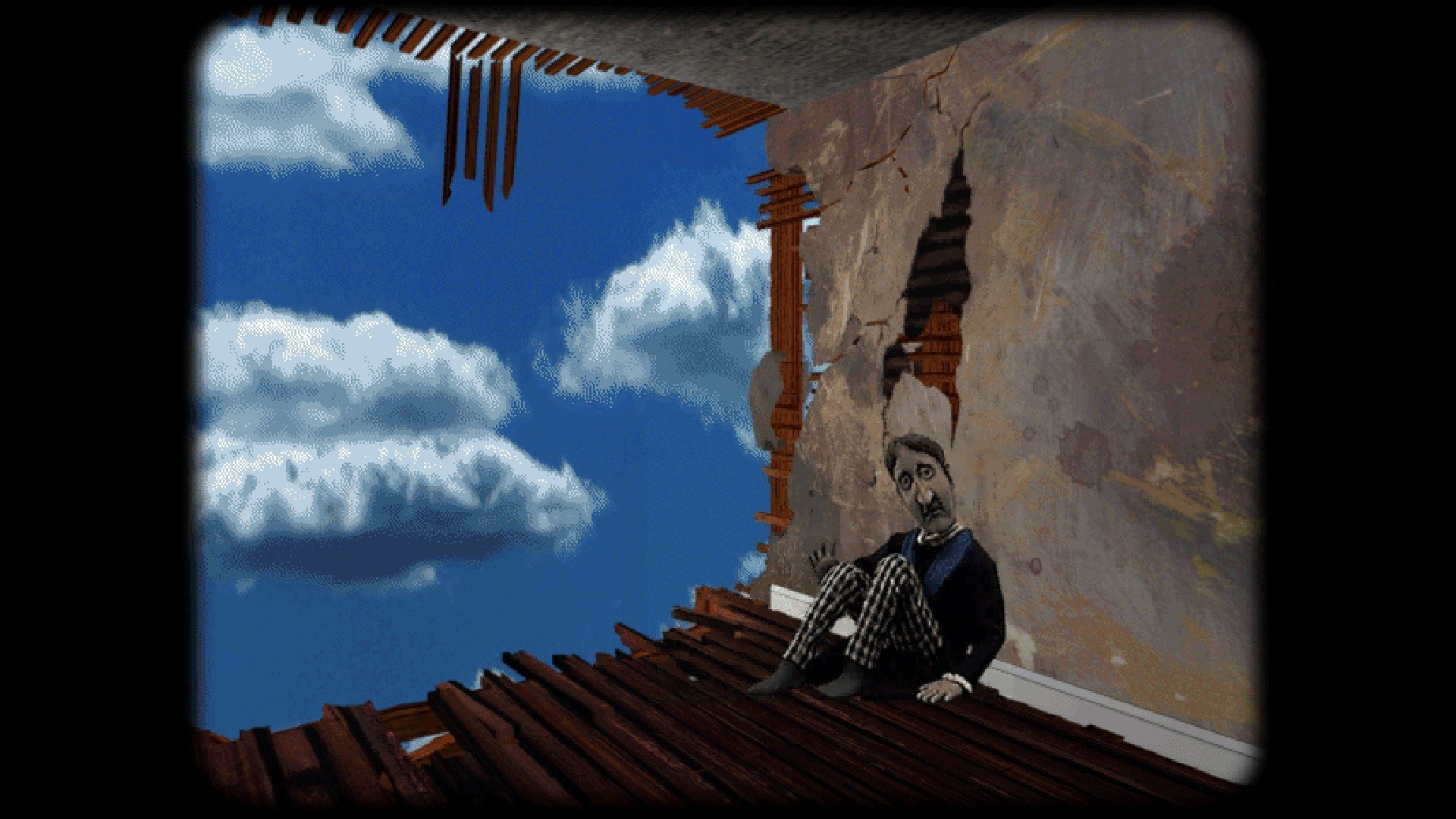
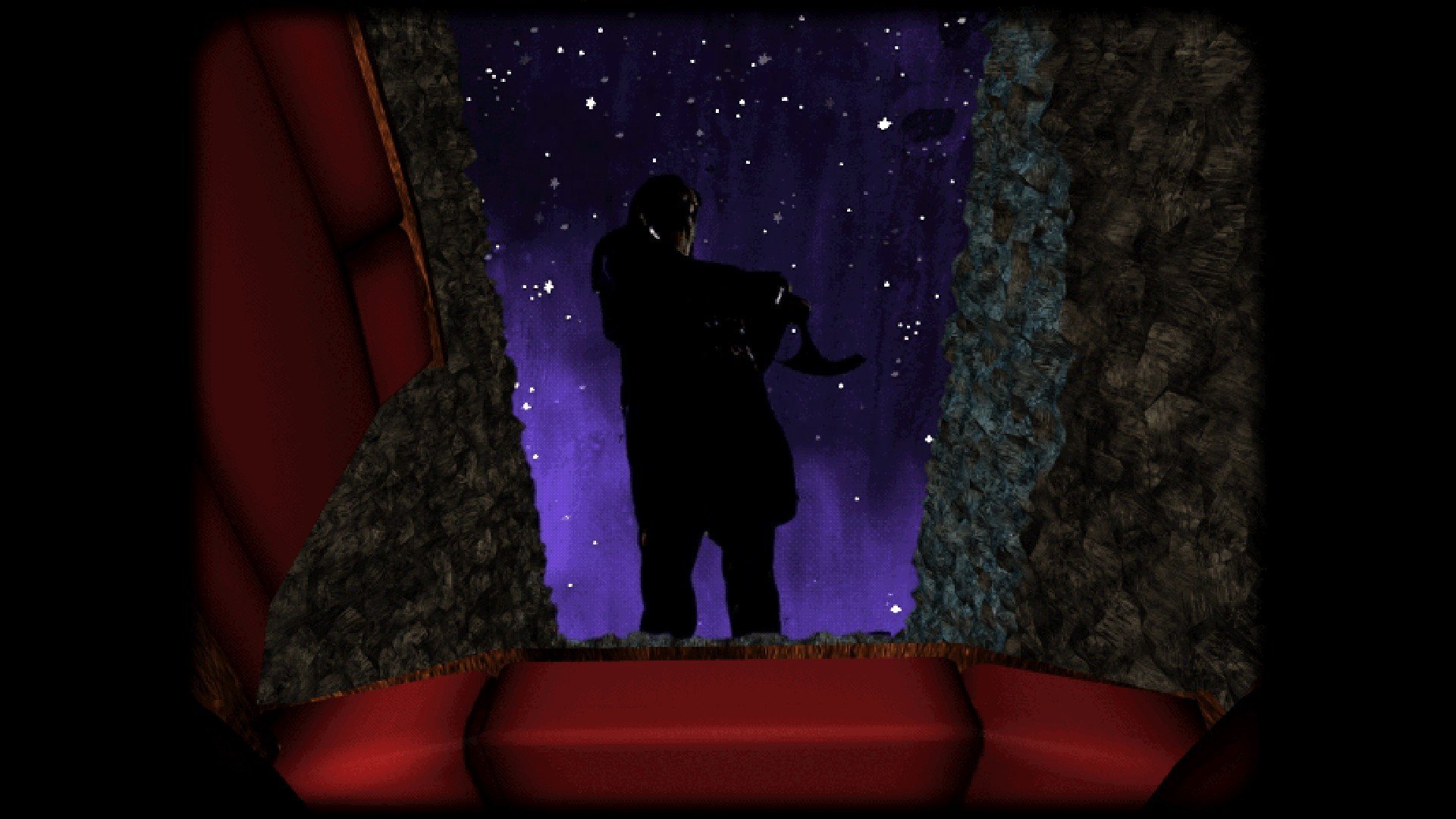
The light gameplay and lack of any real puzzles could be seen as a detriment, but it allows for The Dark Eye’s incredible stop-motion puppetry production and theatrical performances to shine bright. From the moment the game began, I was absolutely stunned by the attention to detail in the hand-crafted clay puppets that acted out every scene. Characters have a distinct, intentionally unnatural look, with dark shadows in place of eyes for most individuals you meet, and a slight sickly gray skin tone that makes them look almost corpse-like. The costuming of each puppet is also exquisitely detailed, with period-accurate Victorian-era garb. Puppet mouths don’t articulate with dialogue, but expressive hand motions and other sweeping movements help sell these clay models as living (albeit disconcerting in appearance) people.
Aside from the impressive puppeteering, the now-dated mid-90s pre-rendered CGI backgrounds work perfectly in adding to the surreal feeling of the game. While exploring Edwin’s manor, the walls appear scrawled with lines of illegible text made even more unnerving due to the low-quality compression of the era in which the visuals were created. Walkways are sparse in detail, feeling like liminal spaces where the stop-motion puppets act out their dramatic displays. And act they do, as the portrayals in The Dark Eye feel more like performance art than a typical line reading. The killer in “The Tell-Tale Heart” speaks as if delivering a monologue in a play, chewing every dramatic phrase as the sound of a beating heart torments his grand triumph. Henry and Elise swoon for each other with Shakespearean levels of angst that likely would have felt cheesy if this was a typical FMV game.
The bow tying the presentation together is the absolutely haunting score and sound design. Many sections have no music at all, but when it’s there, you’re enveloped by soft violin and mysterious synth pieces with thunder and screams worked into the melody. When no music is playing, the loud ticking of a clock or birds chirping breaks the silence. One scene is accompanied with nothing but the soft whisper of a single word, over and over again, and is one of the most chilling moments in the entire game.
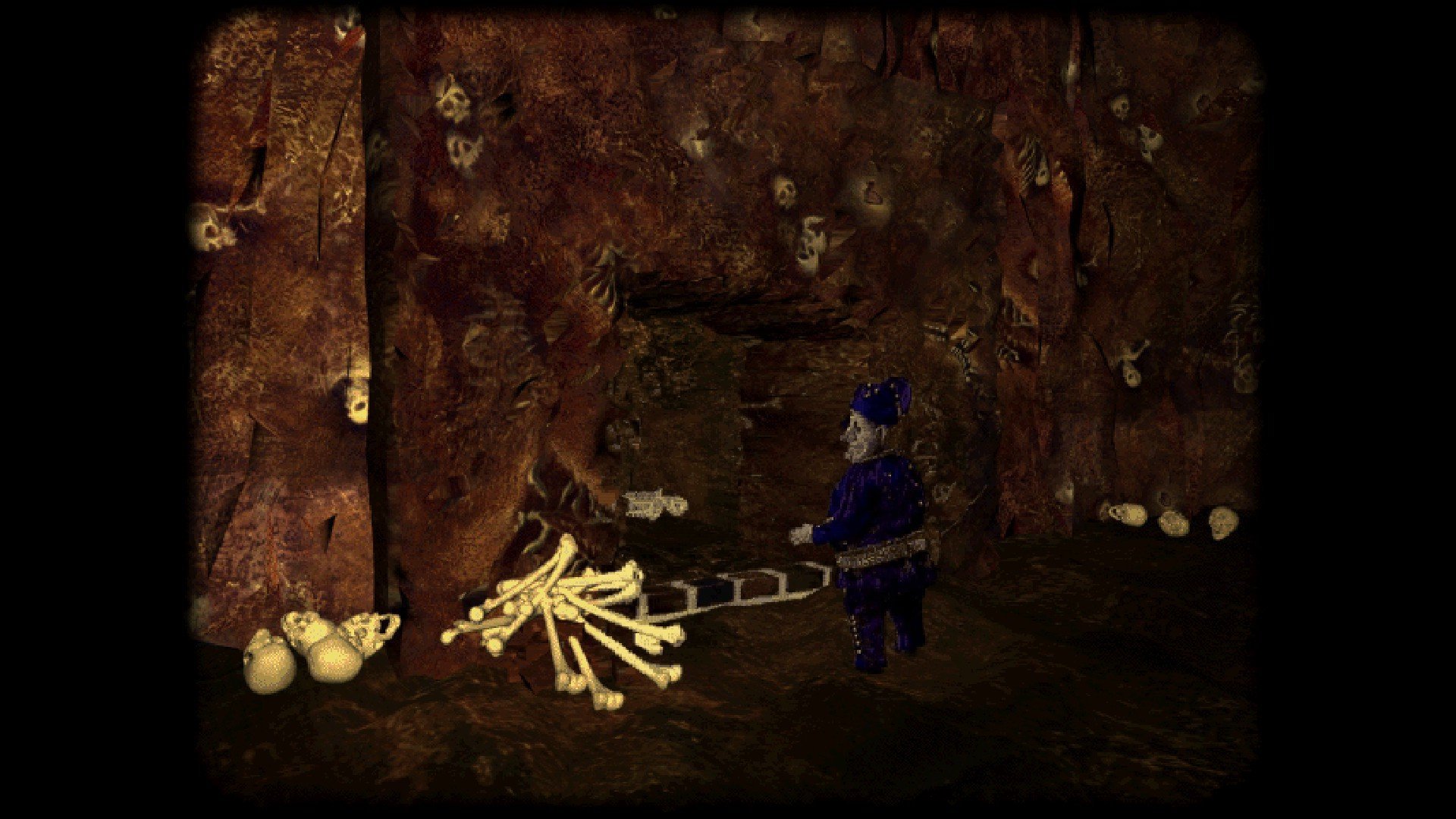
Experiencing Poe’s stories from within certainly makes for a uniquely macabre experience, even if you’ve read these tales a thousand times. “The Tell-Tale Heart” recounts a madman’s careful planning and brutal murder of an old man he lives with for the crime of having one of his eyes looking a bit spooky. “The Cask of Amontillado” follows a man named Montresor leading his friend Fortunato down a deep catacomb before burying him alive brick by brick. “Berenice” tells of a man named Egaeus who is engaged to his cousin Berenice, and how he becomes obsessed with her teeth, in both life and in death.
Edgar Allan Poe's Interactive Horror: 1995 Edition
| Genre: | Horror |
|---|---|
| Presentation: | 2D or 2.5D, Slideshow |
| Theme: | Adaptation, Psychological |
| Perspective: | First-Person |
| Graphic Style: | Stop motion, Hand-crafted |
| Gameplay: | Puzzle, Narrative |
| Control: | Point-and-click |
| Game Length: | Short (1-5 hours) |
| Difficulty: | Low |
The stories told from the original perspective of the killers are all just as creepy and compelling as when I first read them years ago, but what makes The Dark Eye especially fascinating is including the additional viewpoint of the victims in each tale that were previously not touched on in Poe’s works. Curiously, at various points while playing these tales, the screen will zoom in on the face of the killer or victim (if you’re playing the killer then the victim, and vice versa). A reflection of the other character will flash in their eyes, and at that moment you have the ability to change over to the beginning of their role in the story. (You’ll still need to go back and complete the original character’s story later to finish the game, but when you do you’ll resume from the exact scene where you switched perspectives.)
In the victim role, you learn entirely new details about the doomed individuals that give them significantly more personality. The old man dreams of his late wife after cheerfully humming to himself before bed. Fortunato drinks a glass or two of wine before following his friend into the catacombs, and witnessing Montresor’s face through the wall as he slides the last brick into place is chilling on a completely different level from actually playing Montresor performing the deed. My favorite new storyline was Berenice’s, in which you see this poor woman slowly succumbing to an illness while madly in love with Egaeus, especially knowing the grisly fate that awaits her in the end.
But while The Dark Eye’s presentation and the stories themselves have aged like a fine wine, unfortunately the same can’t be said for other aspects. While controlling the game is simple, finding what you actually need to interact with in a scene can lead to long periods of moving back and forth, clicking everything your cursor changes over. Pixel hunting for what is or isn’t a hotspot is bad enough, but it’s exacerbated by the cursor not changing in a snappy motion between one indicator to the next. When you move your cursor close enough to the side of the screen to trigger a directional marker, for a brief moment your cursor takes on the look of an open hand rather than a pointing one. There were so many instances during my playthrough when I was scouring the screen for an interactive object and I would see my cursor change shape, only to accidentally move to a different scene because I clicked before it finished animating.
Actually, I should say “playthroughs,” as this is a bug-filled release with a particularly nasty soft lock during “The Cask of Amontillado” chapter. During my first attempt, I led the unfortunate Fortunato to the deepest part of a catacomb with the intention of burying him alive. However, when I got him to the point where he was to be trapped, the game simply wouldn’t let me interact with the triggering mechanism required to progress. After clicking every option for half an hour and getting nowhere, I checked online to see if I was missing something and, sure enough, I had to click on the trap before interacting with Fortunato in the cavern. (This is apparently a known issue with the original build of the game, but I was unfortunately not aware of this until after the fact.)
At this point, the only way to progress was to restart the chapter and re-attempt the trap. There’s just one problem: I had no clue how to restart the chapter. The pause menu lists only “New,” “Begin,” “Remove,” “Credits,” and “Quit.” Instead of “Resume” or “Continue,” whenever you boot up the start menu after exiting out of the game, hitting “Begin” on your highlighted save file will take you to a beautiful-yet-twisted 2D Picasso-esque portrait of a man’s head, with different parts of his psyche being filled in as you progress (each part corresponding to one of the Poe stories you’ve completed). From this 2D image, I attempted to find a way to reset progress on the chapter I was playing for another shot at triggering the trap correctly. When I couldn’t, I moved back to the main pause menu and figured I could use “Remove” to get rid of my progress for that chapter. Turns out, that function deletes your save file entirely and doesn’t prompt any sort of warning before doing so. As a result, I lost about an hour and a half of progress and had to restart the game from the beginning.
This leads back to the edition of the game put out by GMedia as Edgar Allan Poe’s Interactive Horror: 1995 Edition. Aside from a launcher that boots up upon starting, this is the ScummVM version of The Dark Eye with no changes to the original. While functional, that fan-developed build of the game still has known performance issues, from that nasty catacomb soft lock to the audio getting cut off during cutscenes that play whenever you first start a chapter as a killer or victim. The ending cinematic runs at a different speed than every other scene in the game, and while this is always how it has played out as far as I can tell from researching the game’s version histories, I legitimately thought this was a glitch in the video being displayed. These bugs have long been known issues, so the release of Edgar Allan Poe’s Interactive Horror: 1995 Edition in 2026 should have involved testing and bug fixing to make this a polished modern release of the game.
Even with the launcher, which appears to be the one thing specifically developed by GMedia, there’s a problem. After first starting, I clicked an option on the launcher to have it not keep showing up on subsequent boot-ups. It was only later that I found out that all of the Steam achievements for the game are linked to that launcher, so if it does not appear on-screen, it doesn’t register any of your progress toward the game’s achievements. Since I had disabled it, the game never even recorded that I completed it or performed any of the other achievement tasks. I’m not someone that strives towards unlocking achievements by any means, but the fact that the singular aspect of the game that isn’t from the original developers or the fans at ScummVM doesn’t work properly makes this re-release feel disappointingly cheap.
Final Verdict
Edgar Allan Poe’s Interactive Horror: 1995 Edition is both the welcome return of a cult classic and a missed opportunity to present the definitive version of a wickedly weird hidden gem from the mid-90s. While The Dark Eye is far from perfect, it’s a deeply fascinating 3-4 hour experience that doesn’t feel quite like anything else out there today (or from the time of its original release, for that matter). The over-the-top theatrical performances where you get to take part in some of Poe’s finest works are a blast to play through, even if a large chunk of that play time is spent combing the same few scenes until something new happens. If nothing else (and frankly, there’s really nothing else) this game is a readily accessible option for those like me, which wouldn’t have existed without its re-release, old bugs and cumbersome new name and all.
Hot take
After a quarter-century entombed in obscurity, The Dark Eye is revived as Edgar Allan Poe’s Interactive Horror: 1995 Edition, a still-flawed yet serviceable gateway into the fascinatingly nightmarish world of a dark cult favorite.
Pros
- Delightfully macabre presentation holds up remarkably well even after 30 years
- Chilling musical score and haunting sound design
- Fully voiced dialogue with the dramatic flair of a theater production
- Enjoyable retellings of classic Poe stories experienced from two different perspectives
Cons
- Retains original bugs and even introduces new ones
- Lots of pixel hunting required
- Cumbersome to navigate, largely due to lag between cursor mode changes
Sam played Edgar Allan Poe’s Interactive Horror: 1995 Edition on PC using a review code provided by the game's publisher.




0 Comments
Want to join the discussion? Leave a comment as guest, sign in or register in our forums.
Leave a comment