
Kill the Shadow review
- 0 Comments

Story outshines gameplay in this grim alternate-history adventure RPG Chinese murder mystery
Deduction mysteries are all the rage these days, and while many of them are great experiences that really make you think and work those little gray cells, some don’t really require all that much deduction after all. Kill the Shadow falls more in the latter category, as its gameplay is so streamlined that it makes detective work almost trivial. Thankfully, what starts out as a murder investigation quickly gradually uncovers new layers of conspiracy and political intrigue. As a game it may be overly simplistic, but as a supernatural cyber-noir story, it’s a gripping tale with light roleplaying elements, set in a uniquely conceived and designed alternate-history post-war world.
The story starts in Dark Tide City, a fictional Chinese city divided in half between north and south areas. The northern part of the city is one big industrial factory. The dictatorial Imperial body has a tight grip here, but acts of revolt are growing. The southern area is ruled by a handful of families that are only out for themselves, leaving the common citizen to fend for themselves. This too often leads to social unrest, though not as bad as in the north.
Against this backdrop, we are introduced to a young rookie officer named Lucas as he enters the local police station. This short sequence acts as an in-game tutorial that gets you acquainted with the controls. The game can be played with either keyboard and mouse or controller, and I opted for the former, moving Lucas around via the WASD keys and interacting with various other keys, all of which felt intuitive.
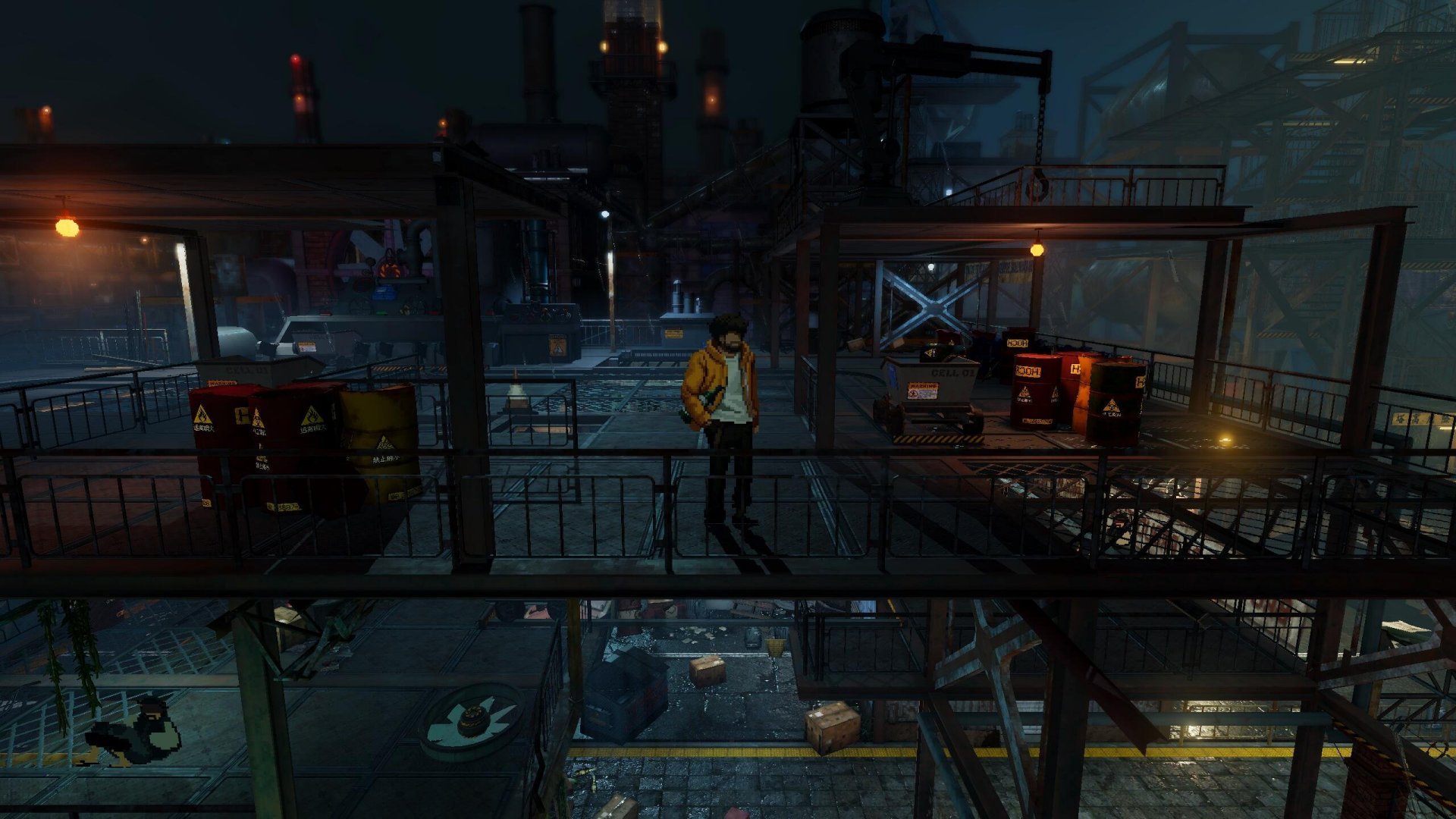
After several minutes of wandering around the station and meeting Lucas’s mentor Uncle Smith, the building erupts in fire and our protagonist wakes up from what turns out to be a nightmare of events past. It is really ten years later and Lucas is now working in the factory in the northern part of the city. This is one of the shortest parts of Kill the Shadow, which is too bad as it’s my favorite. In this industrial workplace everyone must fill their quotas (of what is never revealed) for the Imperials. This leads you to your first investigation, as Captain Theo is withholding rations for the workers until the death of his dog has been solved.
Of course it’s up you, as Lucas, to look into the matter. Talking to people and picking up evidence, you’re able to quickly deduce the culprit and then it’s on to the city’s divisional checkpoint with a pass you’ve acquired to leave the dismal factory and head south. The world-building here is the reason I enjoyed this part most, as we can see just how much of a stranglehold the Imperials have on the city. The guards are willing to shoot anyone who tries to cross the border without hesitation, and we even see a group of protestors trying to fight the power.
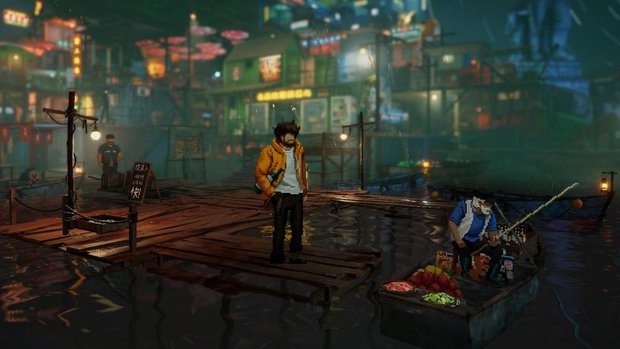
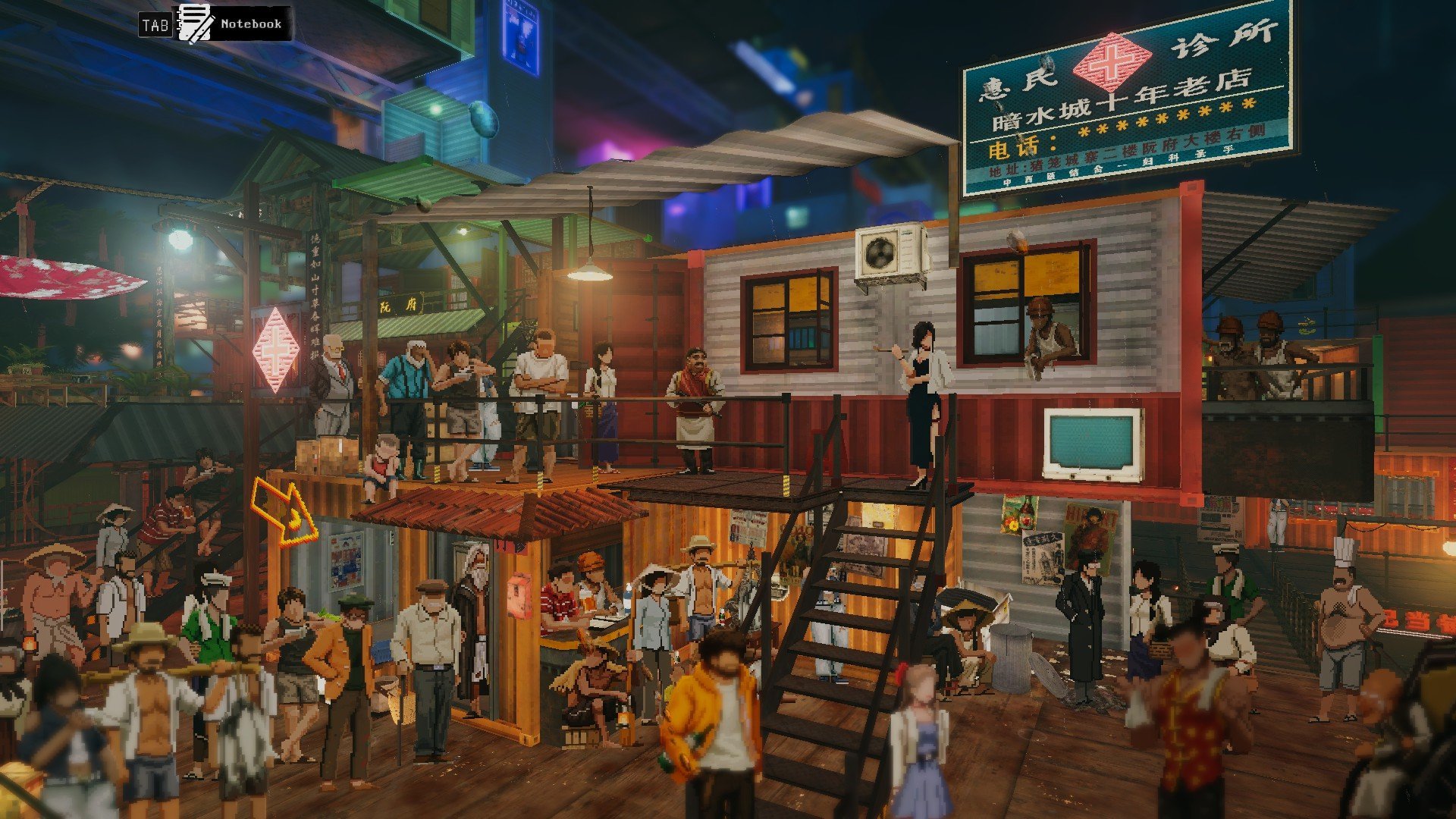
After you manage to leave the north behind, it’s off to Pig Cage Walled City, which was built on stilts over the water. This is where the vast majority of Kill the Shadow takes place, and it’s full of even more intrigue and political maneuverings. It’s plain to see how much the citizens of this city are being oppressed by both the Imperial court and the local wealthy families. Here you look for Lucas’s old mentor Uncle Smith, who is investigating the death of Master Reed, a member of one of the ruling families.
The actual investigation has you wandering around questioning people and searching for clues. As you discover little bits and bobs of information, they are added to your evidence board and can be sorted according to which part of the investigation you’re working on at the time. It’s a kind of mind map but presented as an actual board, filled up with clues color-coded by pushpins. Some require answers, achieved by dragging the question to the appropriately colored clue. Once each current question has been answered correctly, it gets a big old red check mark and you can move on to the next one.
These answers are very easy to suss out so long as you’ve been paying attention to the extensive dialogue. (There is a lot of talking in Kill the Shadow.) So easy, in fact, that for a game that relies heavily on deductive reasoning, this major selling point falls rather flat. I had absolutely no problems figuring out what went where, and I’m not exactly the smartest person when it comes to this type of game. If you do get stuck, you can ask for a hint regarding where to connect the dots. But here too the game oversimplifies things, as it doesn’t actually give you a hint but rather spells out exactly where to draw the line, making the deduction aspect even more trivial.
Kill the Shadow

| Genre: | Mystery |
|---|---|
| Presentation: | 2D or 2.5D, Side-scroller |
| Theme: | Crime solving, Futuristic |
| Perspective: | Third-Person |
| Graphic Style: | Pixel art |
| Gameplay: | Investigative, RPG, Choices matter |
| Control: | Direct Control |
| Game Length: | Long (more than 10 hours) |
| Difficulty: | Low |
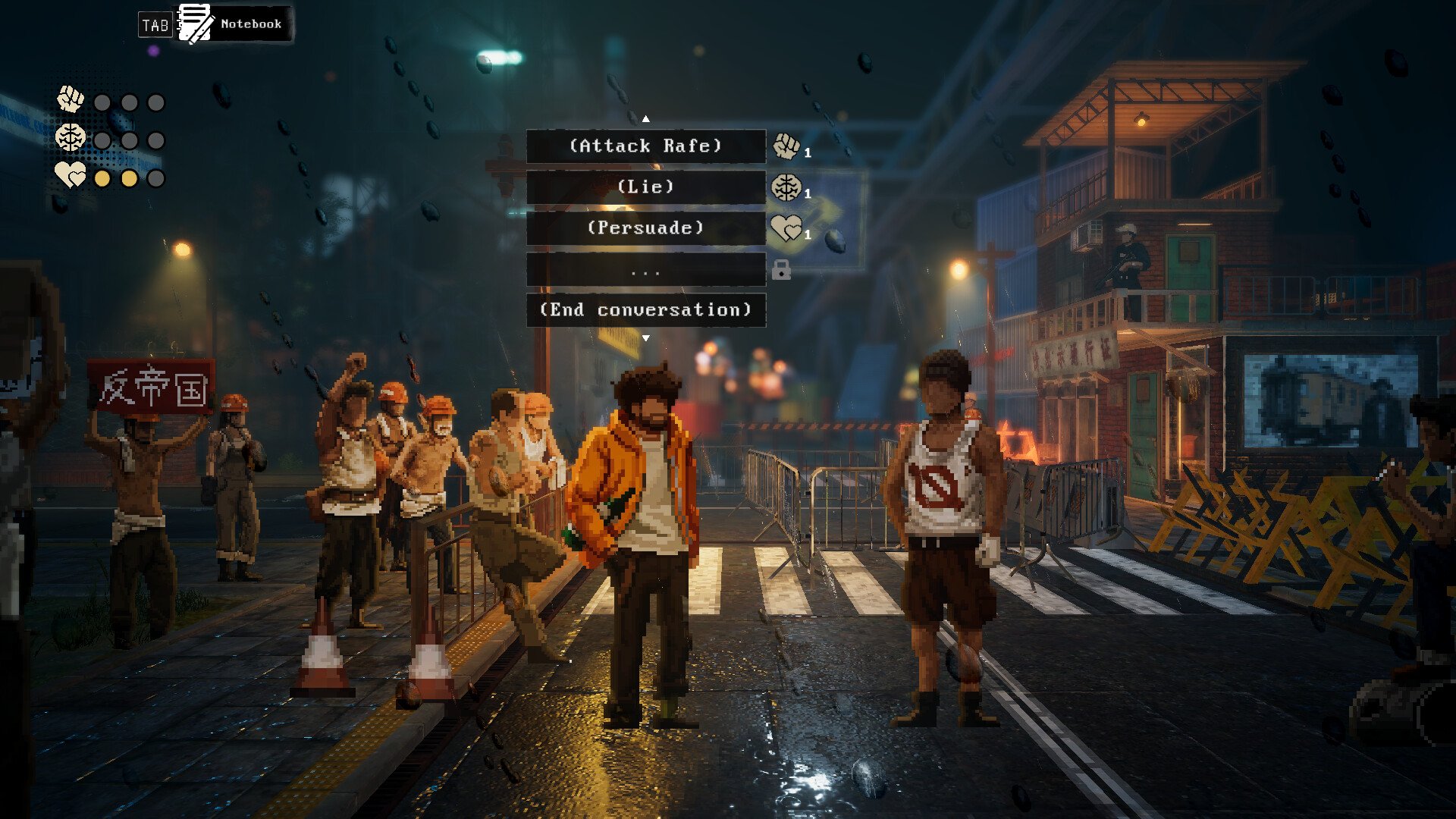
You’ll acquire necessary items for use as you explore, but along with solving conventional inventory puzzles, there are also some light RPG elements to deal with – specifically, three stats that open up extra dialogue options. Some conversations allow you to select what can best be described as “brawn” (fist icon), “brain”, and “charm” (heart icon) approaches, each with its own meter that can fill up and be depleted. If you’d like to try for a better, more targeted response in conversation, you can spend the points required to pick your desired option, so long as you have enough of that stat banked. As an example, you can choose to punch a character or to calmly talk them into divulging specific information (usually with the heart or brain icons). How you play the game can affect the way various characters react to you, and even lead to different endings.
Various items can refill the meters for related stats, and you can increase the maximum amount of an ability by either consuming items you’ve acquired or bought, or by unlocking certain achievements. These achievements, when unlocked, stay persistent throughout subsequent playthroughs. This means that when starting a “New Game +” you have the advantage of beginning with better stats right away. I didn’t play a second time, but the achievements page shows what boons you get when starting over, usually in the form of stat boosts and even extra starting money for finishing the game once.
It took me about thirteen hours to complete one playthrough of Kill the Shadow, and that’s as a fast reader. Not all of the lines are voiced, and I found the inconsistency jarring. There could be one voiced line, then several that are just text followed by a couple more lines that are voiced. Even when they are voiced, a lot of lines sound flat and emotionless. There are also several spoken lines that don’t match up with the subtitles, making it hard to follow when trying to read and listen at the same time. It appears there were a number of last-minute changes to the script after all the dialogue was recorded. I recommend either turning off voices or playing with the original Chinese audio enabled instead.
Fortunately the rest of the sound design fits a game that’s full of intrigue and danger. The music swells as the story hits climaxes, with more subdued mellow tunes during the actual investigation into Master Reed’s death. The sound effects are equally immersive at times, like the blowing of wind and the pattering of rain at the start of a monsoon, the occasional squawking and flapping of birds as our protagonist wanders the coastal city, or even just Lucas’s footsteps as he walks around on wooden boards.
The game’s unique art style is a blend of 3D backgrounds and pixel characters. It’s a dark adventure, literally, as all the action seems to take place at night, which makes the individual scene lighting all the more important. The factory feels like an unfinished construction, all gray corrugated metal, steel platforms and beams, industrial fans, and utilitarian ladders. By contrast, Pig Cage Walled City gives off much more of a lived-in, residential Asian vibe. There is a doctor’s office, several stores and restaurants, and even a stage for live performances (which becomes very important late in the game). Each character is shown with no facial details, though close-up portraits during dialogue sequences fill in the gaps. I preferred seeing how each main character really looks, but the disparate styles work well enough.
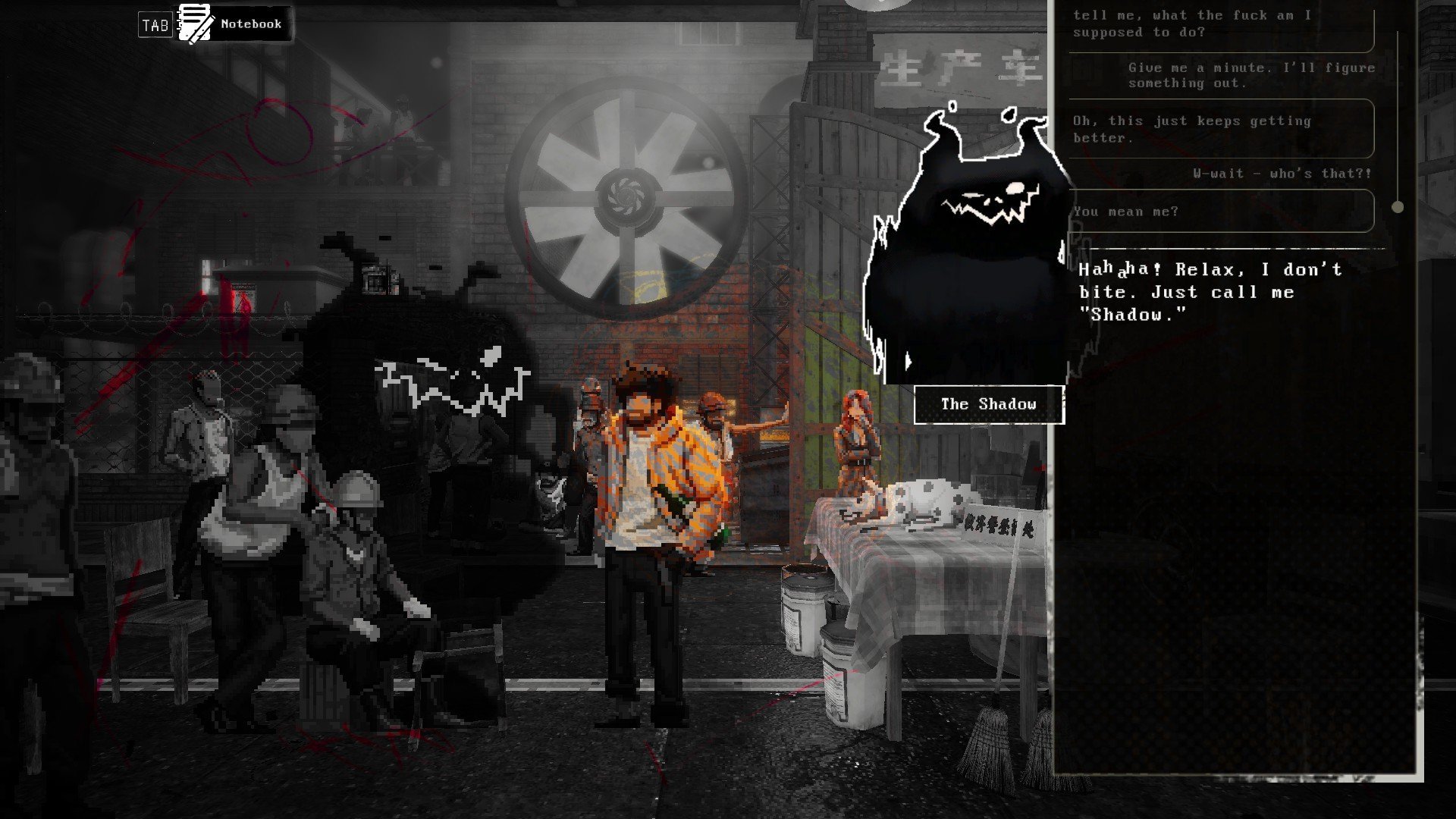
Every single NPC in Kill the Shadow is filled with personality, even if the voice-overs do them no favors. From the widowed Mrs. Reed who is obviously hiding something, to the young and precocious Kiki and her brother Max, and even the heads of the four major houses, everyone oozes charm – or a lack thereof. You can easily tell there’s a lot more going on here than just a simple murder.
Another thing that separates this game from most detective mysteries is that Lucas is accompanied by the titular Shadow, which can recall past events that Lucas did not personally witness. In fact, this ability to “rewind” time is required several times. Any area that automatically fills up with black-and-white scribbles lets you investigate what occurred there previously. Once you have acquired enough initial clues, you can fully rewind the scenario and glimpse events that took place days, weeks, or even years earlier. Most of the time this is presented as a cutscene, whereby you can move the action backwards or forwards to see events play out and hear any conversations between characters. The weirdest part is when a rewind manifests itself in the real world, such as when you need to fix a hole in the wooden walkways.
The Shadow itself has been with Lucas for the full ten years between the prologue and the start of the game proper. This being seems to act as an extension of the protagonist’s subconscious, quickly becoming apparent that it’s a part of him. The lingering question, though, is how it knows things that Lucas shouldn’t. That part isn’t explained at all, even towards the end. The two spend quite a bit of time in the game talking to each other, playing off what they know so far in the case. The Shadow will ask you certain questions, and it’s up to you to answer them. If you get them wrong, it will chastise you to think harder. Despite the title of this game, never did I get the sense that you’re actually meant to kill your shadowy companion. Rather than something you’re trying to get rid of, Lucas couldn’t succeed in his investigation without it.
All the political intrigue and evolving plot details had me wanting to know more until I got a semi-satisfying ending. There are several outcomes you can unlock, though you’d have to replay the entire game to get them all. I only played once, and the ending I got was appropriate for how I played. I tried to make Lucas empathetic and caring about the people around him, even the more jerkish characters, and for the most part I managed to get the closure I wanted. Still, there’s an achievement for a “perfect” ending, which tempts me to go back and try for this finale.
Final Verdict
Kill the Shadow is far from a perfect game. Still, if you’re willing to overlook some glaring audio issues and the deduction aspect being extremely easy, there’s a lot to enjoy here. The story and unique world in which it’s set are worth the price of admission, and they kept me motivated to see how the murder mystery played out. There were several times I thought the game was about to wrap up when it suddenly hit me with more narrative twists and turns, making me wonder just how far the political conspiracy would go. With its distinctive artistic design and substantial play time, those who don’t mind a lack of challenge should find it worth the trip to Dark Tide City.
Hot take
Despite some audio issues and an overly easy deduction system, Kill the Shadow’s compelling supernatural story successfully immerses players in the machinations of its fictional post-war Chinese world.
Pros
- Gripping tale of murder, political maneuvering, and resistance to authority in a unique world
- Lite RPG elements allow for alternate choices and replayability
- Time-reversal mechanic adds a welcome element to the investigation
- Shadow character makes for an interesting internal companion
- Stat progression remains when unlocking New Game +
Cons
- Voice acting is uneven and flat, with some lines not matching the text
- Incredibly easy evidence board deductions
- Hint system provides solutions outright
Serena played Kill the Shadow on PC using a review code provided by the game's publisher.
- Advertisement
- Help support AGH by advertising with us








0 Comments
Want to join the discussion? Leave a comment as guest, sign in or register in our forums.
Leave a comment