
Order of the Sinking Star review
- 0 Comments

Jonathan Blow drops another stellar collection of puzzles wrapped in a glowing presentation
Order of the Sinking Star is the newest game by Jonathan Blow (Braid, The Witness), a brain-teasing extravaganza drawing inspiration from four free puzzle games and mashing their mechanics together and expanding on them in a wonderfully challenging experience that will stump even the most seasoned of gamers. Boasting over 1000 hand-crafted puzzles, there is a LOT of game to be played across its four distinct realms, each introducing different styles of puzzles, though not all of it is necessary to finish. It took me around 40 hours to reach the first ending, but there is still so much more after that, with even tougher content to explore. It’s far from a traditional adventure game, but for puzzle lovers there’s no need to sugarcoat it: this is the most enjoyable puzzle gaming experience I’ve had in 2026, and just when I think I’ve understood everything the game has to offer, it continues to surprise and delight me in new ways, even after finishing.
The story of Order of the Sinking Star, while secondary to the staggering number of puzzles, is nevertheless full of intrigue and unanswered questions that will keep you wanting to discover more. The initial player character, the Queen, is transported mid-battle to an unknown land, far away from her loyalist soldiers. The words on the signs are all in a foreign script, but she can read and understand them just fine for some reason. Making your way through a small tutorial area, you soon find yourself at the Crossroads, the intersection of four realms extending in each cardinal direction. Along the ground are stars that when interacted with transport you to a story vignette for each realm, alongside a puzzle to solve. There are also voice recordings left behind by strangers, some definitely more ancient-sounding than others, sharing their findings and discoveries about this liminal space you’ve found yourself in. You get the feeling there’s a greater power at play here that’s curating this strange world, but the only thing to do is to start solving puzzles.
Loosely based on Heroes of Sokoban by Jonah Ostroff, Promesst by Sean Barrett, and Skipping Stones to Lonely Homes and Mirror Isles by Alan Hazelden – each of which in turn drawing heavily from the block-pushing classic Sokoban – this game uses each of its inspirations as the foundation for one of the four realms that make up the Overworld. These are then remixed and refreshed into a puzzling experience unlike any other, with new mechanics and rules introduced that make for a very smart game that rewards thinking both logically and outside of the box while applying solutions in unorthodox ways.
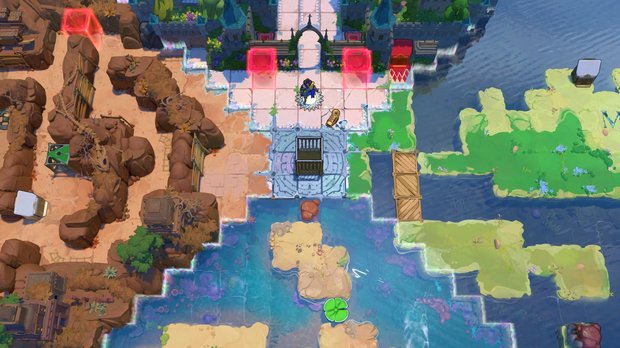
Each yellow star on the ground of the Overworld represents an individual puzzle, which you experience by controlling characters from the four realms themselves. Every puzzle, regardless of realm, is presented by default with a bird’s-eye view of grid-based tiles. Most puzzles come in a self-contained room; only a few are more complex with multiple scenes.
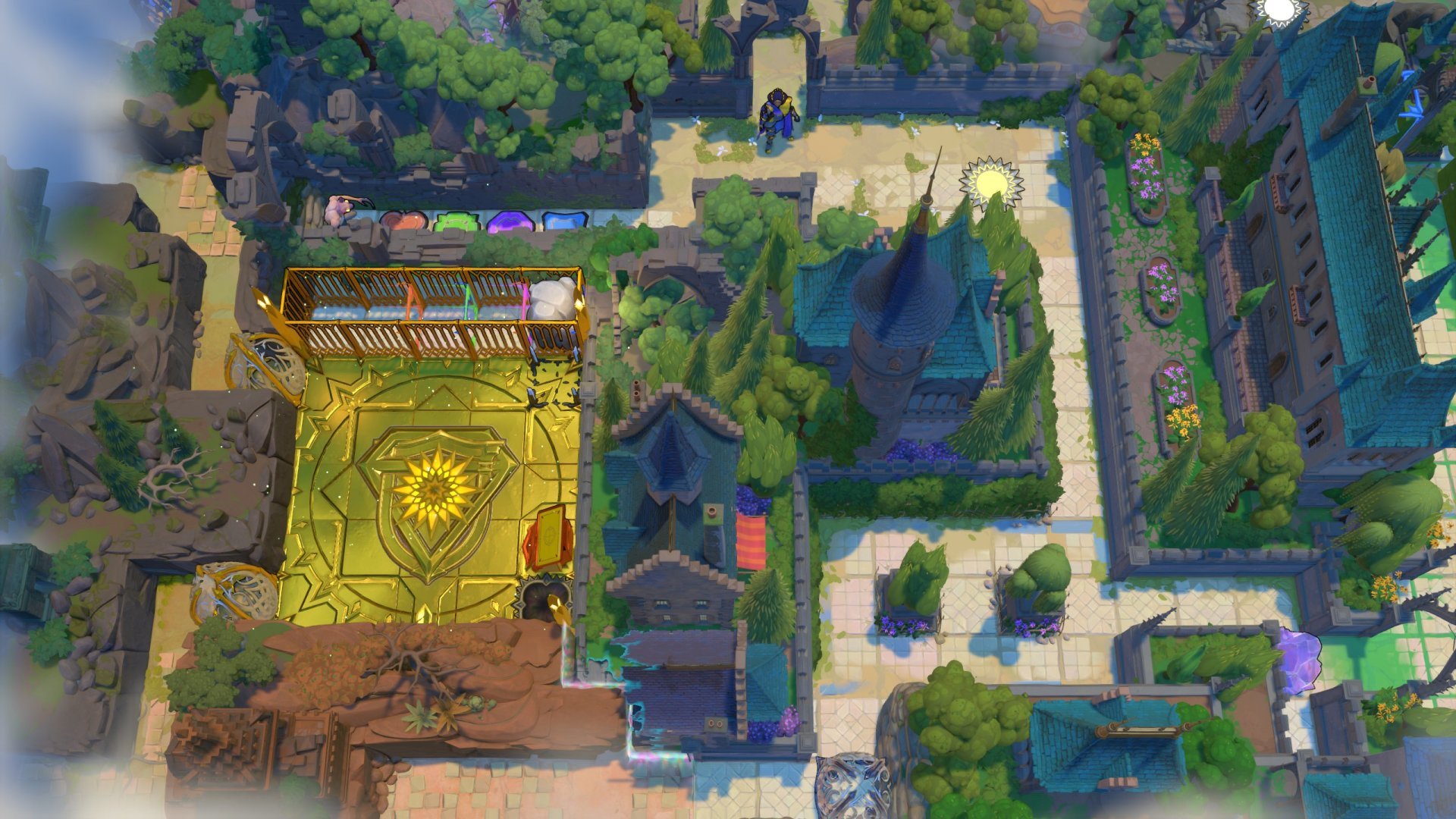
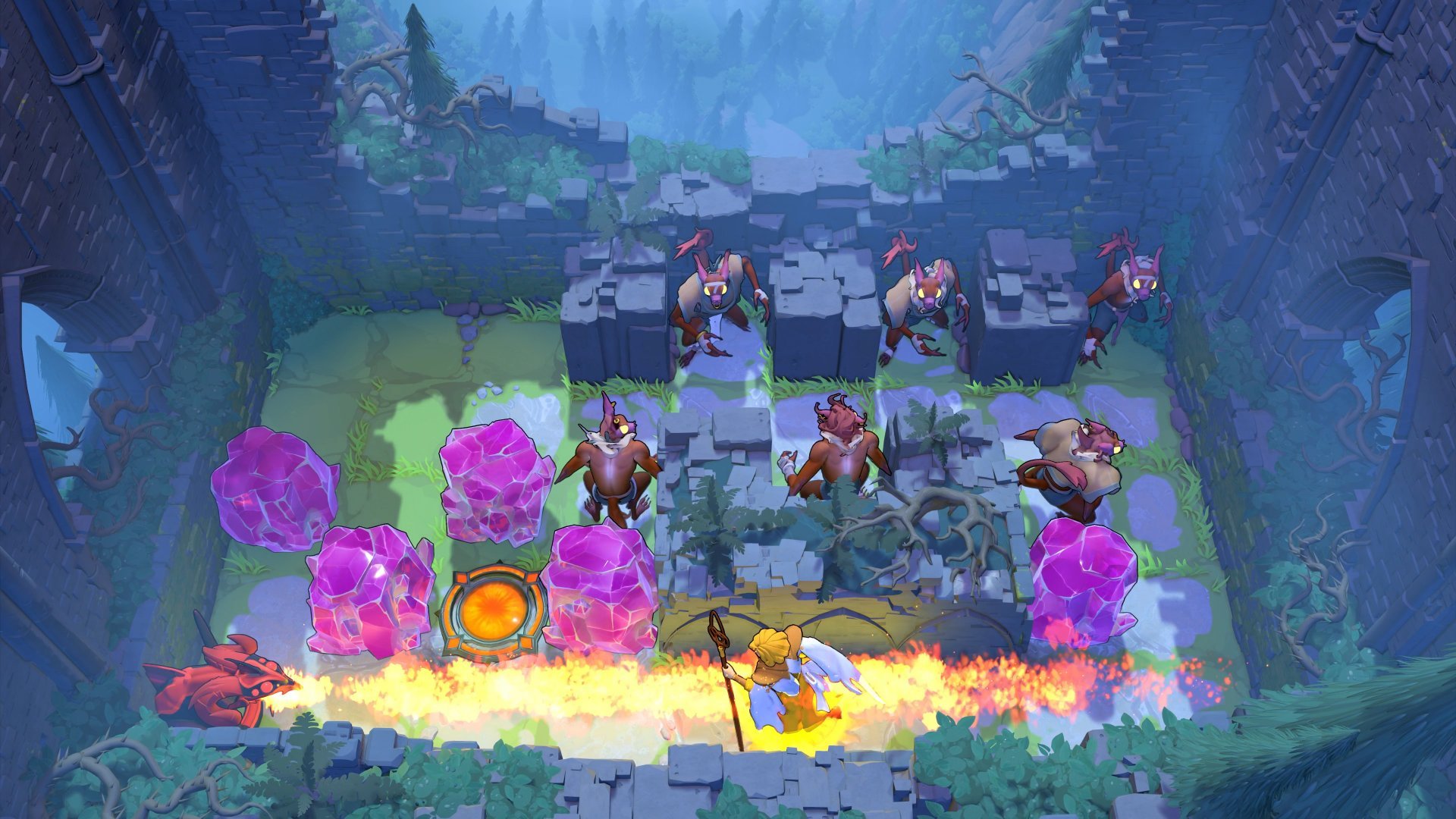
To the North lie the Heroes of Hauling, an adventuring party turned moving company caught in the middle of a conspiracy to frame them by their last employer, the Magistrate. Their puzzles are all about moving blocks in different ways to navigate past monsters and environmental hazards as they chase after the Magistrate to clear their names. These challenges start by introducing each individual hero and their specific power, then broaden to include multiple members of the party using their abilities together to clear the level.
Each hero has a different method of interacting with blocks: the warrior pushes, the thief pulls, the wizard teleports, and later additions to the party interact with them in even more extreme ways, such as controlling their movement through music and transforming other living beings into rocks (yes, that includes other heroes). These puzzles also feature a range of monsters, from goblins that will kill anyone standing directly next to them, to dragons that will breathe fire down an entire column or row if they see an enemy, so it’s up to you to use the various heroes’ skills to manoeuvre around each obstacle.
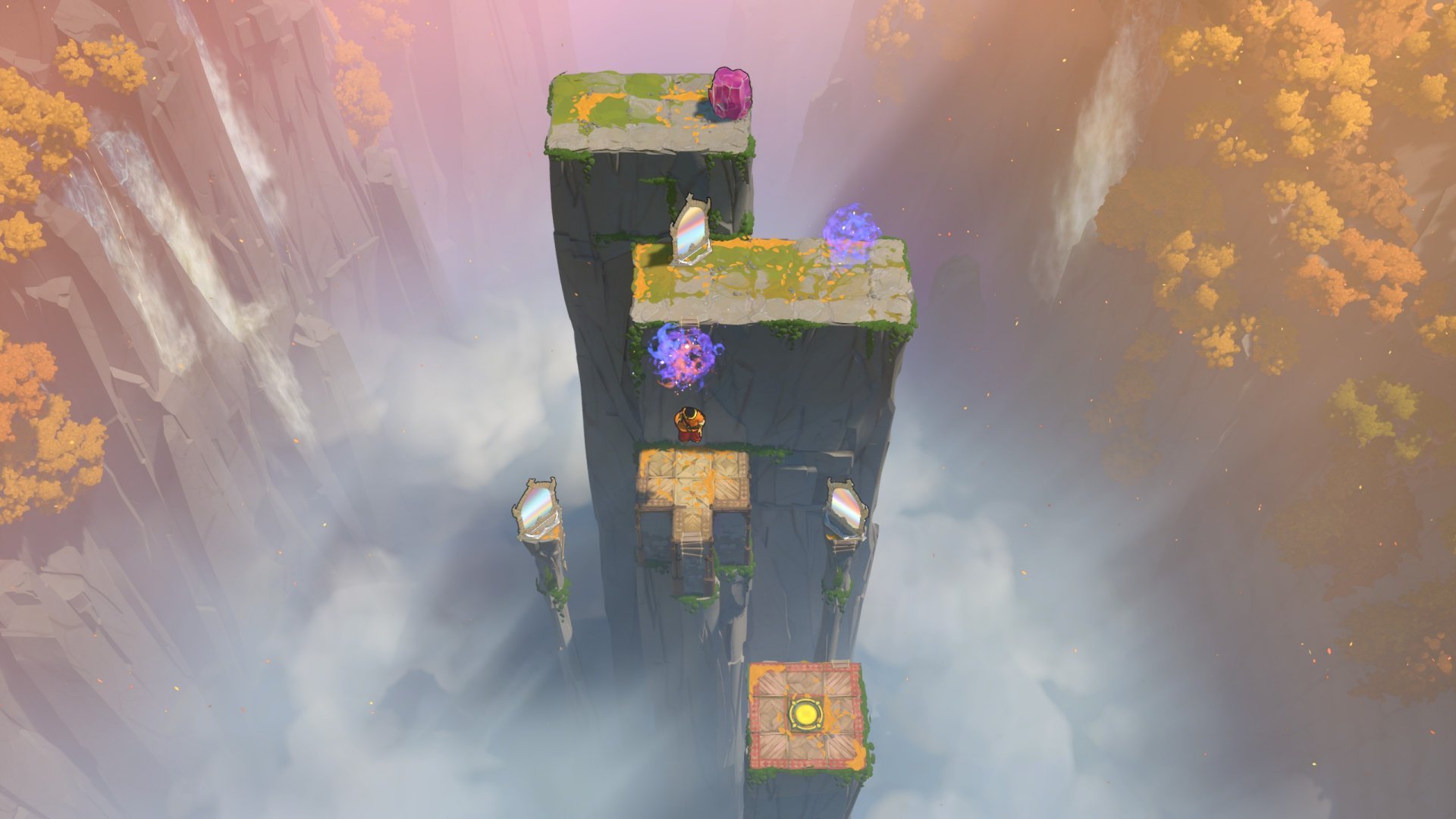
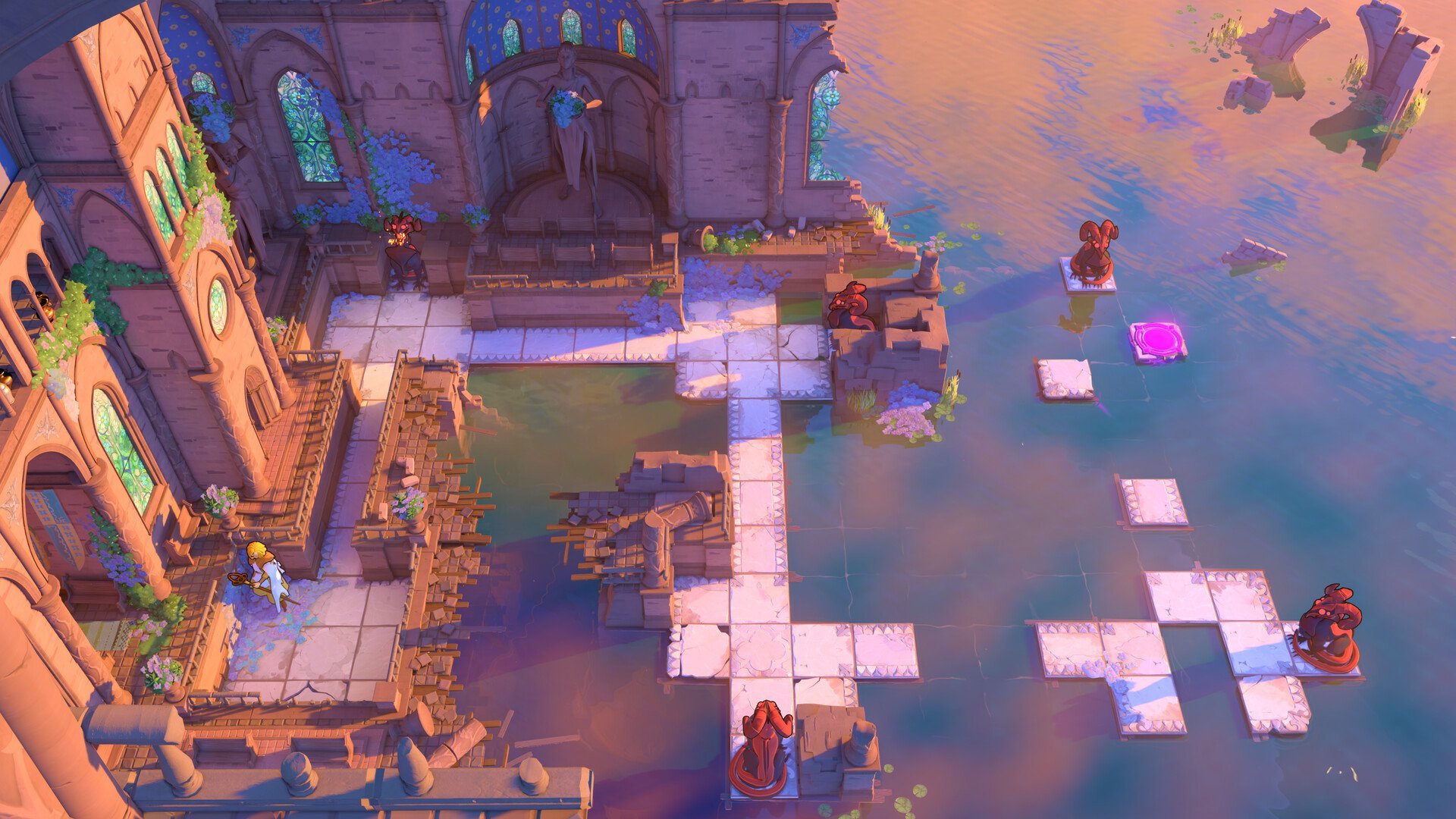
East of the Crossroads are the Mirror Isles, following the Trader as he retakes the trials to become a member of the Mirror Guild after failing in his youth. These puzzles make use of angled mirrors that reflect ghostly images of either crystals or the Trader himself at a 90-degree angle, and when activated act as a method of teleportation. The puzzles here are all about navigating across small islands with the Trader, positioning and using the mirrors to move crystals into the water to create bridges, which becomes increasingly mind-bending as soon as additional mirrors are introduced. What happens when the Trader stands in-between two mirrors facing each other, I wonder?
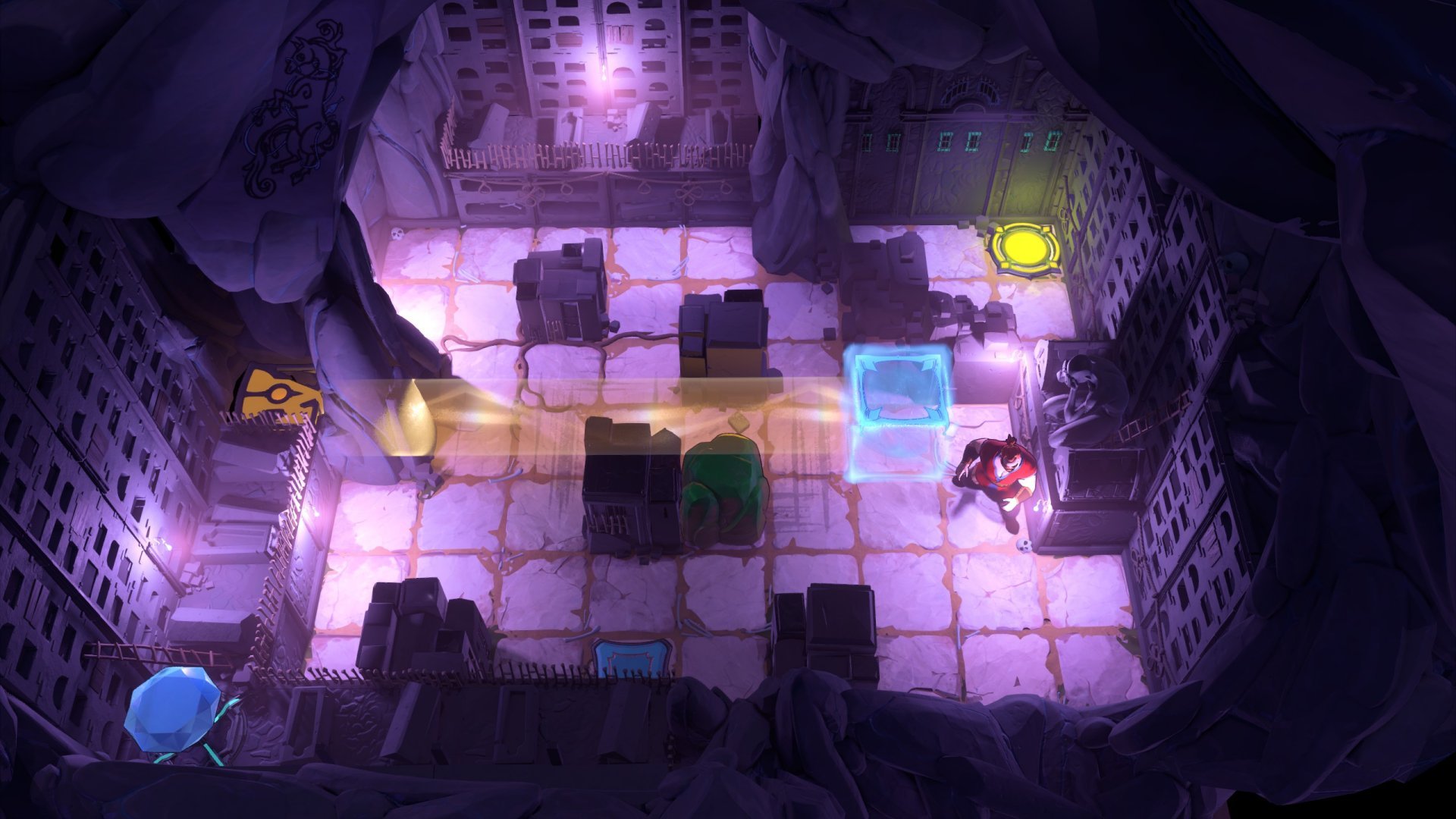
The Vault of the Beamcasters in the West is all about light, as the Caver seeks to gather crystals in long-abandoned mines for the sake of his people. The main campaign puzzles here are far fewer in quantity but are a lot more involved in scale. Each singular puzzle will take you across different levels of sprawling cave systems. There are usually one or two crystals within reach to start, but the majority of them are behind walls, in seemingly impossible-to-reach locations – and trust me, you’ll need to collect all of them.
Once collected, socketing crystals in specific spots will turn on all the lanterns within a 6x6 grid square around it, causing them to cast a straight-line beam to the nearest obstruction while radiating a kind of energy aura within the same 6x6 grid space. Each lantern’s light grants you a different ability depending on its respective colour when you’re standing within its beam, such as teleporting two spaces forward, walking through walls, gaining the strength to push objects, and even breaking rocks, to name a few, making for some very creative solutions to get into otherwise unreachable locations.
Lastly, the Skipping Stones to Lonely Homes in the South features the Sailor and her sentient boat in search of artefacts to bring back to their guild. Similar to the Vault of the Beamcasters, this realm has smaller but more intricate campaign levels, utilising ripples in the water created by skipping stones in order to push lilypads into place to progress. This is also the section with the most timing-based puzzles, as pushing the stones sometimes requires the current it creates to line up with a lilypad already in motion to move it into the correct space.
The keyboard controls are fairly straightforward: arrow keys or WASD to move, X to use whatever special powers are available in any given puzzle, and C to switch between characters. There is also support for gamepads, and controls can be freely rebound to any key or button. The four realms can be tackled in any order, but the game recommends going northwards to the Heroes of Hauling first and then East to the Mirror Isles to get a feel for their respective mechanics before tackling the greater complexity of the other two.
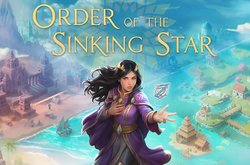
Order of the Sinking Star
| Genre: | Fantasy |
|---|---|
| Presentation: | 2D or 2.5D, Isometric/Overhead |
| Theme: | Magical, Monsters |
| Perspective: | Third-Person |
| Graphic Style: | Stylized |
| Gameplay: | Puzzle |
| Game Length: | Long (more than 10 hours) |
| Action: | Timed events |
| Difficulty: | High |
Regardless of the realm, every puzzle’s end goal is the same: get your character(s) onto the glowing circles, which takes you back into the Overworld and the Queen with the star now white, signifying completion. There’s going to be a lot of trial and error, so thankfully there are some very useful quality-of-life features. Being able to undo your last move is great for puzzles where death is a possibility or have steps that can’t naturally be undone through movement alone, or you can completely reset the puzzle if you feel it’s better to start fresh. In the realms with larger puzzles, pressing Tab will switch the room to a top-down view from the default lower angle. In the Vault of the Beamcasters, this overhead view is zoomed further out, and loops both horizontally and vertically. This can be very disorienting and confusing, but also extremely useful for visualising where the beams of light are going. It just takes some getting used to.
Each realm also has a small narrative sequence that plays out across the first few puzzles that introduces its particular characters and their reason for being in this predicament. These are then supplemented with standalone puzzles introducing new interactions that feed into the more advanced puzzles that utilise them. Solving puzzles will gradually unlock more areas in the Overworld that are focused around a specific mechanic or interaction, such as the Heroes of Hauling introducing new party members with each subsequent zone. Every area’s design is highly intentional in how the new mechanics and their applications are integrated, and it is very well-executed.
Progressing through these puzzles, you’ll eventually encounter one of six gold rooms found around the edges of the four realms, and with it, a unique puzzle. These gold rooms represent the intersection of two realms, and therefore combine their mechanics together: beams of light and mirrors, lilypads and skipping stones with the powers of the heroes, for example, to create some truly challenging puzzles. Completing a gold room then unlocks a bigger area dedicated to the combination of these two realms, with still more brainteasers that add further new interactions and rules based on the unique mechanics of the two individual realms.
This is where Order of the Sinking Star truly shines, challenging you to gather everything you’ve learnt about how a realm works and fit that into the puzzle framework of another realm. It’s also where you’ll probably spend the most time, as in my playthrough I took to some realms much quicker than others, so the combination of two less comfortable realms for me was difficult, to say the least. There’s no help or hint system, which can be frustrating for some of the harder puzzles, but by the time those are introduced, the rules behind all the various mechanics should have been ingrained into you enough that working backwards from the solution can get you to the answer. The feeling of solving a puzzle that has stumped you for ages is exhilarating, and the moments where meaningful progress is made in uncovering more of the Overworld and accessing a new area makes everything leading up to it feel so worth it.
On top of all of this, the Overworld itself is like its own set of puzzles, with new areas sometimes becoming accessible by interacting with the environment, pushing rocks into place, or activating a beam of light that shoots across the entire map. The mechanics within each realm are brought into the Overworld too for the Queen to use directly. She has the ability to push objects herself, and each realm’s section in the Overworld is littered with objects relating to that area’s specific puzzles – mirrors in the Mirror Isles and lanterns in Vault of the Beamcasters, to name just a couple.
The various themed sections as you venture deeper into each realm are often impossible to access at first. Usually there’s a rock that can’t be pushed the first time you encounter it due to its relative position to you, a mirror that falls barely short of teleporting you into the next area of the Overworld, or an unpowered lantern just out of reach. Finding your way past these obstacles is a puzzle in itself, but once accomplished is almost always accompanied by a sun symbol on the ground that acts as a fast travel point, connecting the various sections of each realm in the Overworld. The map of the latter also shows you what puzzles you’ve seen and have yet to complete, with each incomplete challenge glowing pink.
Presentation-wise, Order of the Sinking Star has cute 3D graphics that give it a cosy vibe, even when there’s monsters about. The Queen and the various other playable characters all have charming colourful designs that make them easily distinguishable from each other, with slightly exaggerated proportions like that of a cartoon. The monsters are equally whimsical and goofy looking, with big, wide-open bug-eyes and over-the-top sound effects when making their attacks or dying.
Each realm is visually striking, with vastly different environments. Personal favourites include the Heroes of Hauling puzzles surrounded by the spires and walls of a castle, and those that take place within a marketplace featuring food stalls and other shops that need to be navigated. These stand in sharp contrast to the icy, snow-covered Mirror Isles and the largely aquatic world of the Sailor, with its vast array of sandy beaches, wooden docks stretching out across the water, and an orange earth that is unlike the other four realms.
The characters you meet are all nicely voiced by a professional cast, including Liam O’Brien of TV animation and Critical Role fame as the Warrior, Emily O’Brien (no relation) from Death Stranding and the original voice of Y'shtola in Final Fantasy XIV as the Queen, and Darin De Paul and Anjali Bhimani, best known for voicing Reinhardt and Symmetra in Overwatch as the Wizard and the Bard here, respectively. The musical accompaniment features an excellent orchestral soundtrack with different motifs for each area before they too blend together once the realms collide.
The puzzles are the real star of the show, however, and deservedly so. Not once did I feel like I was stumped with no forward path, or that the game was bottlenecked at a certain unsolvable obstacle. I reached the first ending after about 400 puzzles, though I definitely solved more than the bare minimum required to reach it. At that point there’s a delightful interactive credits section that pays homage to the original four games that served as inspiration before you’re returned to the Crossroads with more puzzles to solve. The game hints at having more than just the one ending, with two additional exits that were inaccessible before, so there’s a lot more optional puzzling left to do.
Final Verdict
Though a veritable puzzle-fest won’t be for everyone, Order of the Sinking Star is one of the games of the year, with an incredible number of brainteasers so well-integrated into a unifying experience that it never feels like it has overstayed its welcome. Constantly introducing new mechanics and applications of existing ones keeps each puzzle fresh and fun, and the overarching story offers enough motivation to keep you wanting to press forward. Beautifully designed with audio to match, the game’s four realms are all interesting, unique, and challenging in different ways to make for an amazing puzzling experience. Add it all up, and this is a game I highly recommend to puzzle fans of all experience levels.
Hot take
Pure puzzlers are BACK with Order of the Sinking Star, a delightfully challenging and constantly surprising new addition to the genre from the creative mind that brought us Braid and The Witness.
Pros
- Very smart puzzle design and execution
- So much game, with over 1000 puzzles
- Overarching story is engaging and blends well with the game’s structure
- Each realm is distinctly unique
- Mixed-mechanic puzzles are especially challenging
Cons
- No hint or help system can be frustrating
Daniel played Order of the Sinking Star on PC using a review code provided by the game's publisher.

- Advertisement
- Help support AGH by advertising with us



0 Comments
Want to join the discussion? Leave a comment as guest, sign in or register in our forums.
Leave a comment