
Scholar Adventure: Mystery of Silence review
- 5 Comments

Hallelujah! It’s a short, easy but compelling start to a new mystery series, set in a secretive remote monastery
Far away on a dark and restless sea, in the middle of a small rocky island, stands an abbey. Once a place of beautiful songs of worship, silence has now overtaken this refuge of devotion and contemplation. Rumors have it that the abbot went crazy overnight, though no outsider is really sure what happened and the monks themselves certainly aren’t blabbing anymore. There’s a mystery to unveil here, and young William, an aspiring writer searching for a thrilling adventure to pen for his first successful novel, travels to the secluded monastery, intent on unlocking all its secrets.
Scholar Adventure: Mystery of Silence is a gripping point-and-click pixel art adventure that may lack much in the way of quantity but doesn’t lack for quality. Not surprisingly, the game is unvoiced but it features haunting music and cool sound effects, a decent number of puzzles (although perhaps too easy), and a supernatural story with its genesis in forbidden love and wrong decisions that’s well worth an evening’s perusement.
Haunting yet solemn music featuring piano and string instruments accompanies William as he makes the water crossing to the abbey with a cloaked ferryman seemingly straight from the River Styx. The plainly pixeled, faceless main character – think The Darkside Detective, only less chunky – fits perfectly into the more detailed gloomy nighttime island setting with a full moon in the background, the screens reminiscent of landscapes in Loom and Lure of the Temptress. Once on the abbey grounds, there’s an unseen cat somewhere meowing its discontent with the world. What I found most amazing were the wind effects; I played the game with headphones, and the blowing breeze makes excellent use of the stereo output, making it sound as if I was indeed outside with a soft, low whistling first in one ear, then in the other, then in both simultaneously.

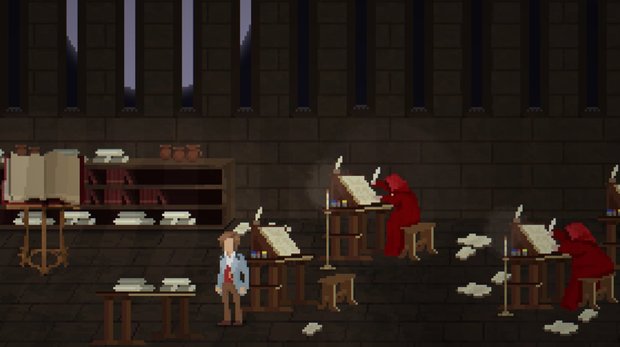
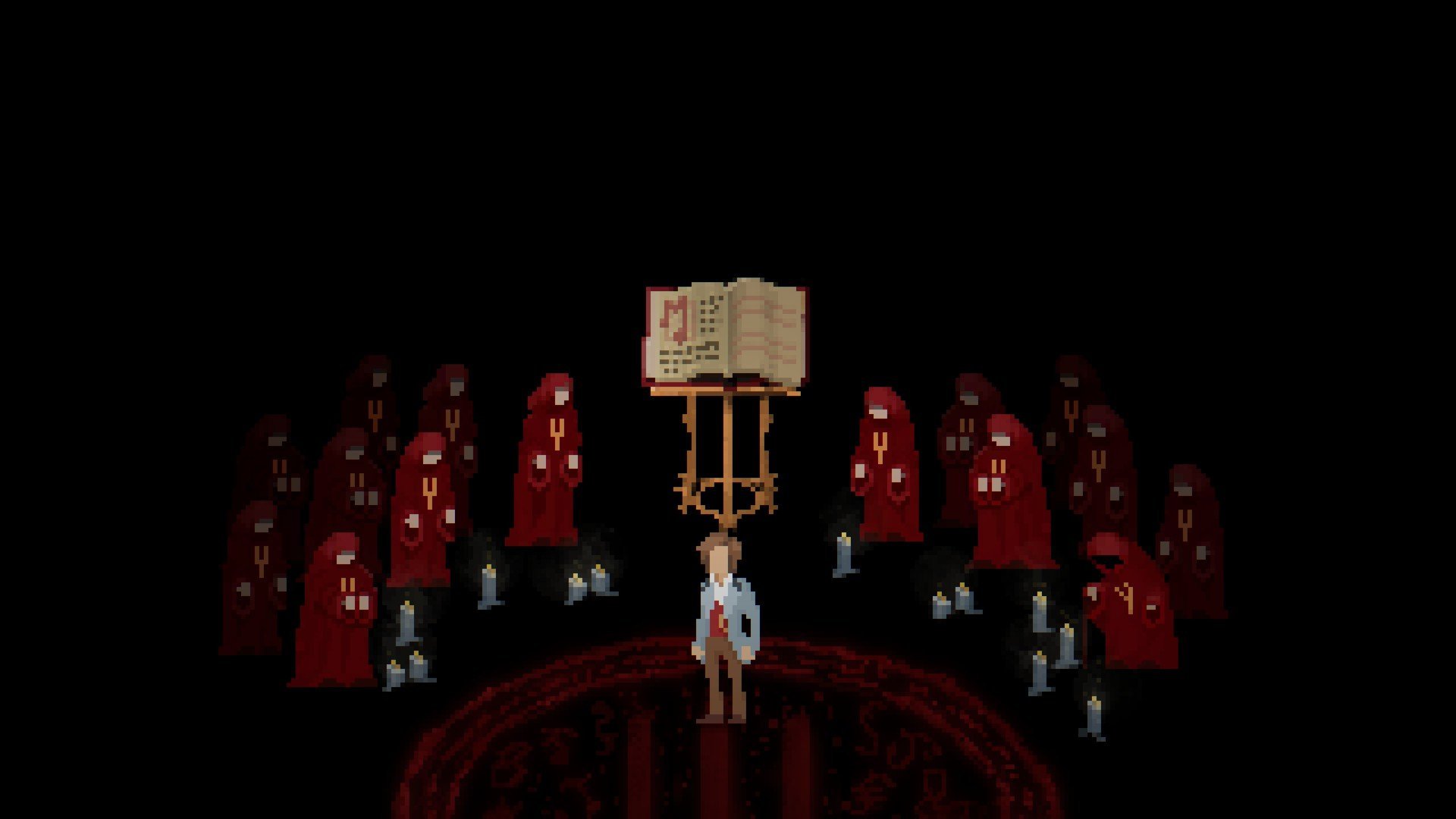
Inside the monastery, the music disappears, only to return during key moments as you progress the story, such as when drums start to beat as you find your way into the monks’ scriptorium. In its place, William’s footsteps echo throughout the halls, while the chains holding the chandeliers squeak as they swing back and forth from the ceiling. A recurrent symbol of a tuning fork adorns the walls, tapestries, plaques above doorways, and even the habits of the monks, clearly indicating how important music once was for this band of brothers.
All this immediately sets the tone for an unsettling mystery where you never quite know what to expect. And I was indeed surprised by the turns the story took. The main focus is uncovering the secret behind the vow of silence these monks were compelled to suddenly take. William is convinced it wasn’t purely a faith-based decision on their part. He feels sure there’s more going on, a suspicion reinforced when he starts finding hidden rooms and passageways, with strange notes and objects covered up or having switched places. There is a clear intent behind this blatant concealment, and a couple of sinister discoveries that aren’t for the faint of heart provide proof that the abbot, even if perhaps not completely crazy, definitely had a hidden agenda not all of his flock supported.
Next to the main story, there’s a tale within the tale to be revealed as well. Most of the new locations you find, from the monastery’s guest rooms to the orchard and the lone bell tower, will contain a piece of paper with part of the love story of “Beatrix and the Count.” While this might seem like a strange discovery to make in a place filled with celibate men, you might be able to put it into perspective once the credits roll.
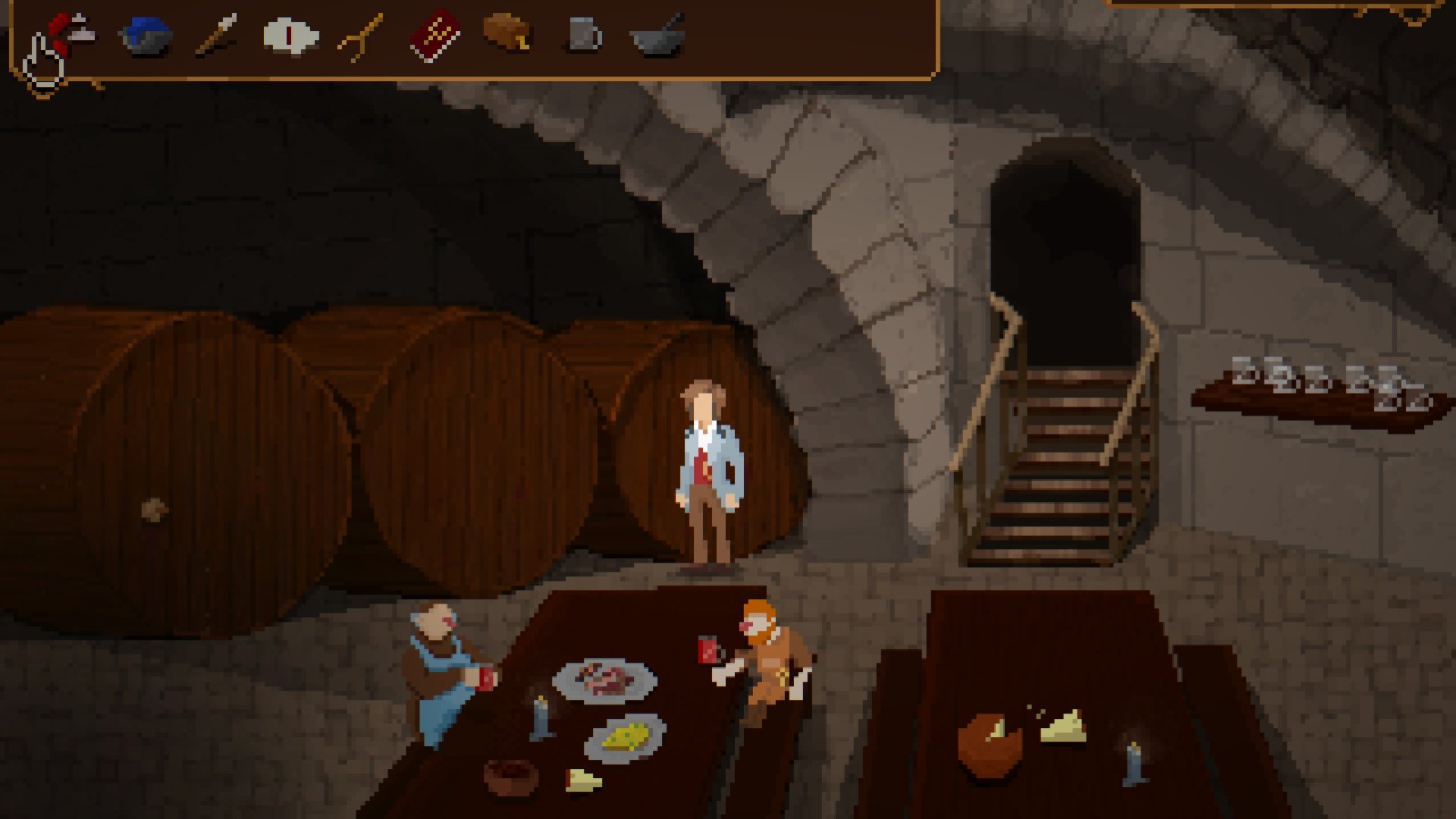
While none of the monks will respond when William addresses them, there are a few characters that do: two non-ecclesiastical brothers in charge of groundskeeping, and a vintner making sure the robed residents don’t run out of their favorite beverage. These three characters offer a welcome change from roaming the halls on your own, with some regular dialogue-based interaction.
At the start of the game, it seems doors mysteriously close and open by themselves, guiding you along a linear path. Soon, however, the entire environment opens up and you’re free to roam the island, your way blocked only by locked doors for which you need to find the keys. Each door brings you closer to the finale, where two different endings determine the fate of the abbey, depending on one optional late-game puzzle that is easy to miss in the heat of the moment.
Scholar Adventure: Mystery of Silence

| Genre: | Mystery |
|---|---|
| Presentation: | 2D or 2.5D |
| Theme: | Conspiracy, Religion/Occult |
| Perspective: | Third-Person |
| Graphic Style: | Pixel art |
| Gameplay: | Investigative, Puzzle |
| Control: | Point-and-click |
| Game Length: | Short (1-5 hours) |
| Difficulty: | Low |
Mystery of Silence employs an intuitive one-click interface. The cursor changes its function automatically depending on what’s needed – an eye to examine, a hand to use or take something, a speech bubble to talk to someone, and another I have never encountered before but is perfectly suited for a story about breaking through the silence: an ear to listen. Not employed all that often, it is a necessary tool for a particular puzzle where the key lies in how an object sounds. (Since the sound effect is not visualized, I’m not sure the hearing impaired will be able to complete this puzzle without some trial and error.)
The hidden inventory can be accessed by hovering the cursor near the top of the screen. One downside to it is that you can’t examine the items you’re carrying. Thankfully they are still labeled, but I would have preferred a bit more information on some of the things I had picked up, or clues as to their nature. For instance, the game starts with a mysterious engraved shape labelled an “obol” in your pocket, and I only realized it was a coin – actually a weight used in ancient Greece as payment – after I tried giving it to the ferryman.
While sufficient detail was lacking there, in contrast there are other places where I found some of the narrator’s text commentary to be quite unnecessary. It would describe all of William’s actions, most of which were things obviously taking place on-screen – the equivalent of “William unlocks the door” after using a key on one – and thus didn’t really need explaining. Also, each time I picked up an item, the narrator would explicitly mention I had taken it, which was pretty obvious to me, and the whole reason I clicked on the object to begin with.
While most puzzles are of the simple “find the key for the door” variety, there are a couple of less obvious inventory puzzles as well, like distracting a guard canary that will tweet like mad when you approach, and finding ways to open up some secret passages. Even these don’t hold much challenge, but they are still fun to solve and are nicely integrated into the setting. With no random obstacles in need of moon logic, the game keeps flowing at a brisk, steady pace.
There are a couple of repetitive parts that are slightly frustrating. I wondered if there wasn’t some other way to get through them, but I never did see any other way than trial and error. At one point, William finds himself in the dark sewers below the abbey, which form a kind of maze with drain pipes leading into other corridors. You need to find the correct path through these pipes to reach the exit, and when you miss one you wind up back where you started. This took me several tries before I got the sequence right.
A second scene involves you beating three different monks guarding an inner sanctum in a game of rock paper scissors. Silly enough as it is, I don’t know whether the sequence is always the same, or if there is some way to predict what an opponent will do. Both this minigame and the sewer sequence seemed to me to be little more than artificial ways to prolong the game a bit.
For such a short game, Mystery of Silence has a wonderful save system. There’s the autosave, which is ingeniously indicated by William whipping out a notebook and jotting something down (though there’s no in-game journal for you to check). You can also save manually whenever you like, and my personal favorite, whenever you exit the game your progress is recorded automatically as well. You can’t die, so saving is only needed to mark your place, though it is certainly handy to save right before the finale if you want to try for both possible endings.
It took me only eighty minutes to finish the game the first time through. The epilogue made me realize I missed something somewhere, however, clued in by William’s doubt about leaving the abbey in its current state. That’s when it hit me that I still hadn’t used a couple of inventory items, and immediately I knew what I had forgotten to do. A quick reload remedied that, and after an extra ten minutes I got a second ending, one that was much more satisfying, with a more content William sailing back home… or to solve yet another mystery somewhere.
Final Verdict
While I would have liked a bit more meat on this bite-sized narrative and a little more challenge to its puzzles, Mystery of Silence definitely scratches that weird and creepy short story itch that lends itself so well to point-and-click games. At only an hour and a half long, the tale moves at a fast pace and the discoveries you make as you get closer to the truth are sure to chill you. The eerie soundscape makes it easy to forget there are no voices (or indeed, much dialogue at all in a game where most characters never speak). Here’s hoping new games in the Scholar Adventure series, which the developers hope to continue, are more substantial than this, but as a first commercial game, they have put together an enjoyable dark tale that makes me yearn for more.
Hot take
It will likely leave you praying for more, as Scholar Adventure: Mystery of Silence takes you on a very short and simple but intriguingly eerie mission in a mysterious abbey teeming with secrets.
Pros
- Eerie music and sound effects suit the dark narrative
- Fast-paced story with an intuitive one-click interface
- Welcome combination of auto, manual and exit saves
Cons
- A couple puzzles seem to exist just to prolong play time
- Superfluous narrator messages break immersion
- A bit too short and easy to be fully engaging
Johnny played Scholar Adventure: Mystery of Silence on PC using a review code provided by the game’s publisher.








5 Comments
Want to join the discussion? Leave a comment as guest, sign in or register in our forums.
Is each episode of this story going to be self-contained, or is the story going to continue from one game to the next?
Reply
While I can't answer with 100% certainty, my understanding all along has been a series of standalone adventures. And the dual endings of this one certainly don't suggest it's a story to be actively continued. (Though there could certainly be a through line tying things together eventually.)
Reply
I just reached out to Ayo to ask this question. I’ll have him answer for ya 😀
Reply
Yes!!... after his first “big success,” William will keep searching for inspiration in new places to tell more stories, always through his own unique perspective. They’ll continue to be short, self-contained stories. Thank you so much for the support! I hope you enjoy William’s adventures.
Reply
Thanks Ayo. So long as the first game won't leave me hanging in suspense 'til the second game comes out, I'm in. Congratulations on publishing your game, looks really nice.
Leave a comment