
Out of Sight review
- 0 Comments

Survival horror starring a blind girl and her teddy is a great-looking game with a surprising amount of heart
Teddy bears. Most of us have had one (or several). They were a security mechanism; a friend when you really needed someone to talk to, or give a hug. These inanimate, cushy little creatures help children deal with stress and get through tough times. Out of Sight is a game about just that, albeit in an extraordinarily stressful situation that hopefully we haven’t had ourselves. Luckily, the teddy bear is just as extraordinary in a horror puzzler that is dazzlingly creepy from start to finish. While it’s not the most challenging experience, both the innovations and nods to classic horror will keep gamers enthralled for the duration of its short but sweet campaign.
Out of Sight begins in total darkness as we hear an adult woman putting a little girl named Sophie to bed. After the woman leaves the room, Sophie begins to cry, lamenting that she does not want to be here anymore. Two spherical dots then manifest on-screen, eventually expanding and coming together to show Sophie in her bedroom – a small, dark little corner in the attic of an old house. Her room is partially illuminated by blue moonlight pouring in through a window, though iron bars sit just outside the pane, blocking it from opening. Sophie, who wears a red blindfold over her eyes, sits up and turns toward the camera as the view comes into focus, stating that maybe you, Teddy, can see for her. She promptly picks you up and leaves the room, formulating an escape plan.
I initially found myself wondering whether the fluttering shadows and creaking noises throughout the eerie, decaying old mansion were an artistic interpretation of Sophie’s young mind imagining things that weren’t really there. However, after coming across several rooms locked with haphazardly installed heavy duty locks, it becomes clear that there is indeed something strange going on in this house, and Sophie is right to be afraid.
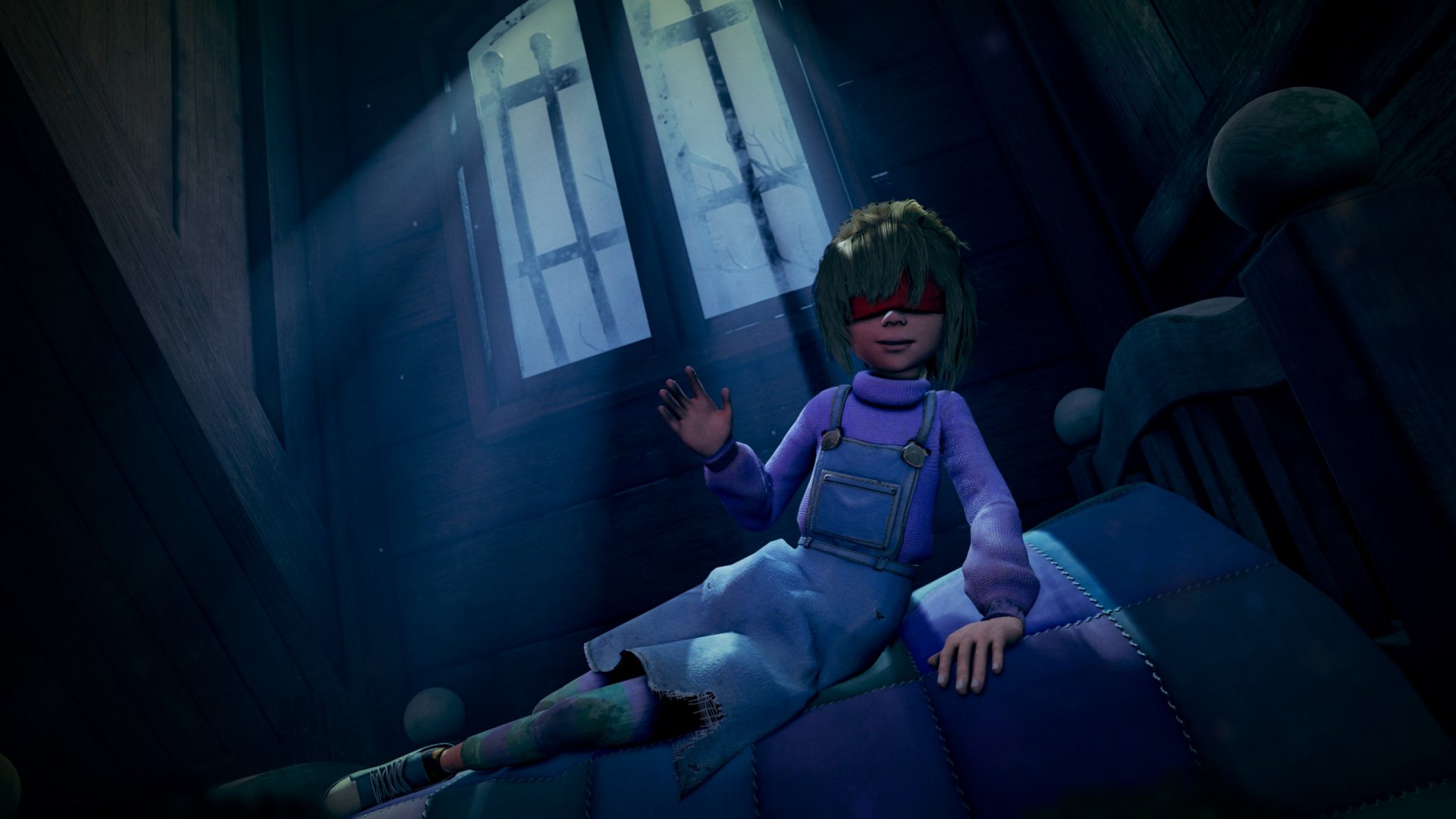
Sophie often talks to Teddy throughout her exploration of this obscurely designed place. She desperately wants to escape, though at first you won’t know why, or who the adults roaming the labyrinthine home are, if not her caregivers. Sophie will state her goals in an immediate, matter-of-fact sort of way, including details like “we have to be very quiet” when she suspects one of the adults is close by. She’ll also talk just for the sake of it, stating things such as “It’s okay to be scared” when performing a particularly tense task. Little details like this tug on the heartstrings, knowing that it’s the defenseless Sophie who is truly scared in that situation. It inspires motivation in the player, even in their relatively helpless form of Teddy, to protect this little girl.
While the house is full of man-made traps that require wits in order to avoid capture, soon enough you’ll discover that there are supernatural forces at work here too. Teddy’s ability to act as Sophie’s eyes is the first hint, but later on the apparitions of other children can be seen roaming the manor as well. While Sophie is initially unsure whether these ghosts are friend or foe, it becomes clearer as you progress that they are indeed trying to help, shutting certain doors or turning on lights in order to guide her to safety. Furthermore, they seem to be the link between Teddy and Sophie’s eyesight.
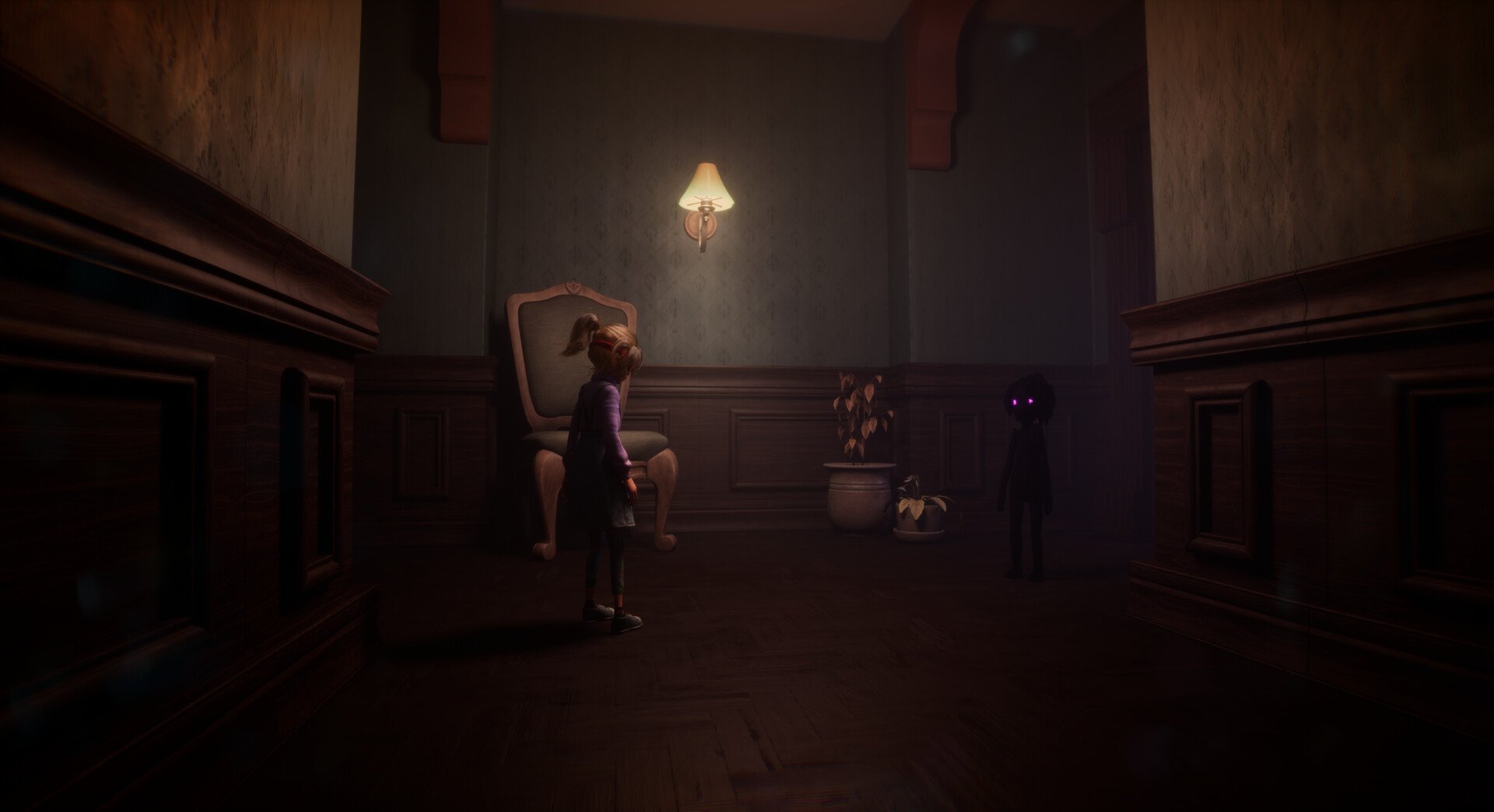
You’ll begin on the upper floors of the house, sneaking through stuffy, turn-of-the-20th-century infrastructure, with offset floorboards and peeling wallpaper, illuminated only by dim lamps and the odd window allowing moonlight into the space. Occasionally there will be a painting, but these are often left on the floor rather than hung on the wall, and overall the decor is sparse and disorganized. Any furniture tends to be arranged in such a way as to create blockades. It’s a barren place, meant not to be a space for living, but rather to control the egress of its trapped inhabitants.
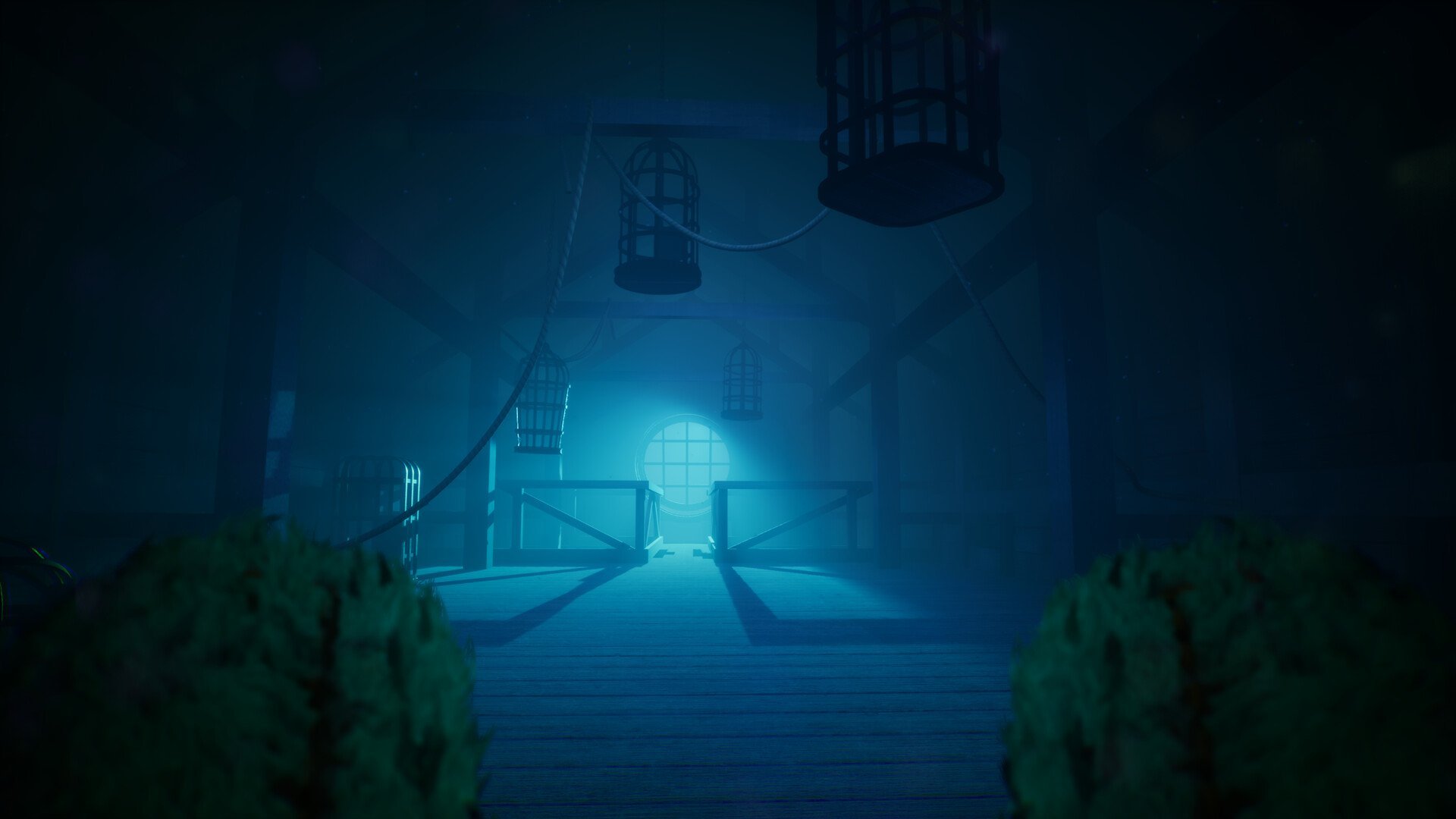
As you navigate the prison-like manor, you’ll occasionally run into one of the two adults wandering the grounds looking for Sophie. You’ll overhear their conversations, giving insight into their plans for her. In the second act, you’ll find yourself in the crypt-like basement of the mansion, where you’ll see firsthand why they want Sophie. It’s a dark and twisted drama involving the theme of loss, with Sophie acting as a sort of conduit for the housemother’s (Janna) ambitions. The story is told solely from Sophie’s perspective, however, and as her goal is only ever to escape her captors, the full scope of the narrative is hidden from you. Hints about why the girl’s eyesight was taken and the importance of a full moon for a ceremony are stressed, but the actual plan remains oblique throughout.
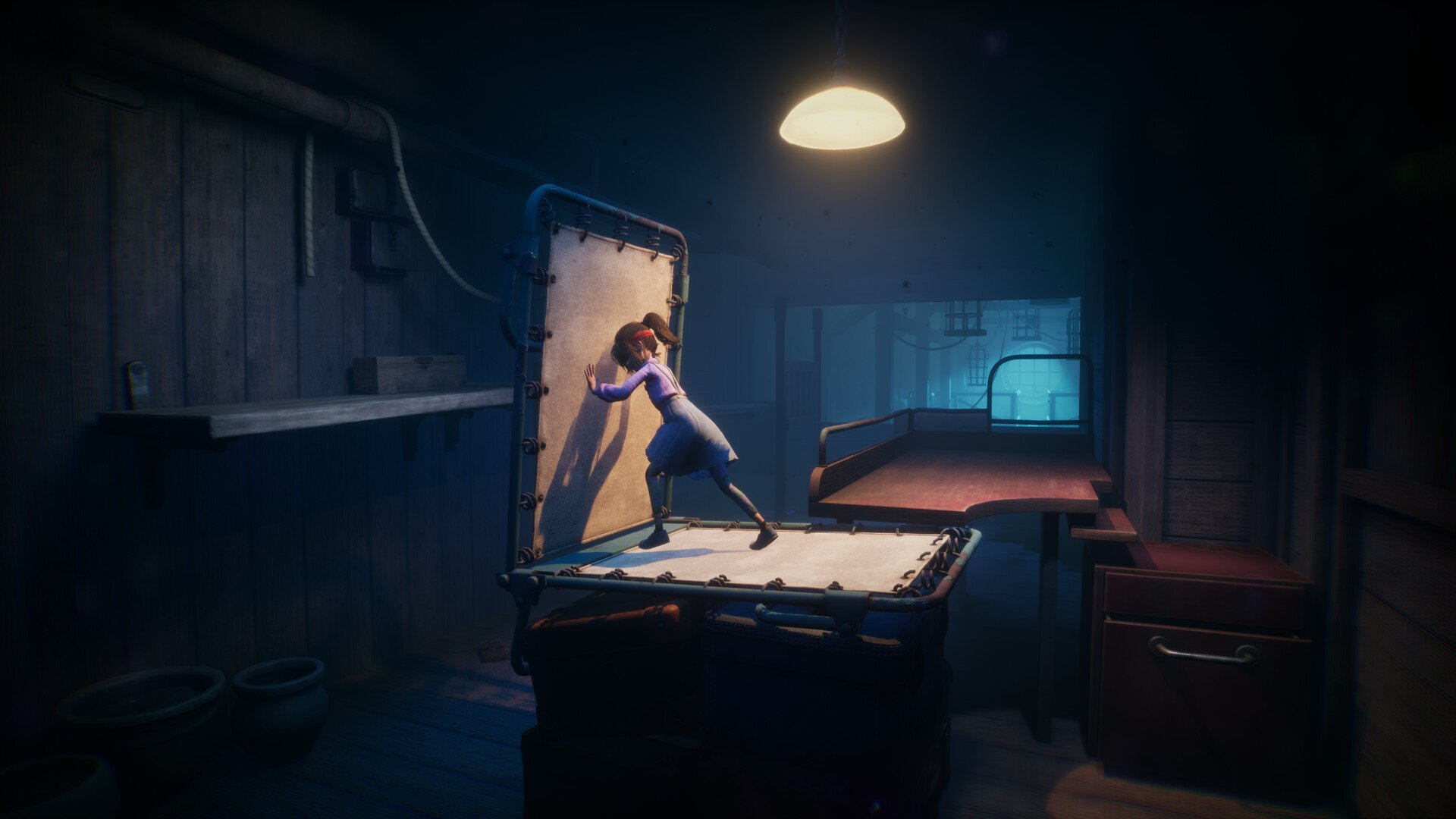
Out of Sight is played from a first-person 3D perspective – or third, depending on how you how look at it (literally). Essentially, players control Teddy’s head and Sophie’s legs as they traverse the manor. Sophie can crouch to get into smaller openings or lift Teddy above her head for a better view, but in order to do anything that requires her hands, like inserting a key into a lock, pushing a piece of furniture, or hoisting herself up a short ledge, she needs to set Teddy down.
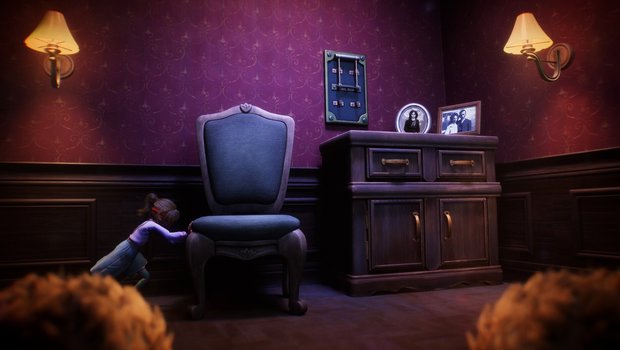
Each room will have a predetermined spot to place Teddy, either a pillow or purple blanket with Teddy’s outline sitting atop it. Once he’s down, Out of Sight plays similarly to a classic survival horror game with fixed camera angles as you guide Sophie through the space alone. Teddy can move his head around, but not his body, limiting the freedom of movement in these sections. You will navigate a series of challenges in this way, like moving boxes or drawers for climbing to the shelf where a key is hanging, opening the door with it, and then finally returning to pick up Teddy.
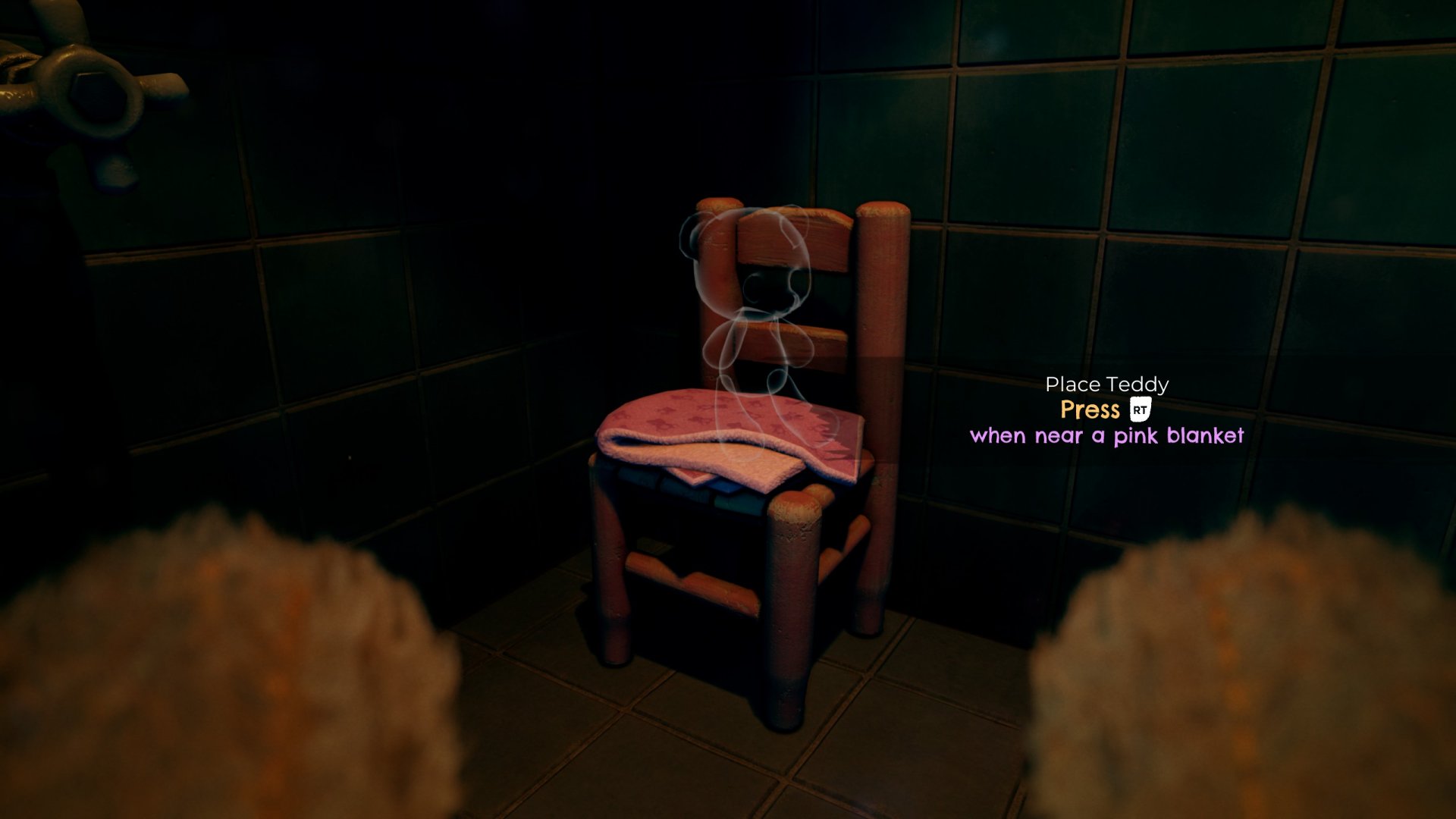
It’s a simple formula built up steadily through the first few rooms, though curveballs quickly come into play. Teddy may need to be put on a movable platform, making him harder to retrieve later on as his placement in the room changes. One of the adults may come looking for Sophie, meaning you will have to hide her under a table or in a dark space until the intruder leaves. Teddy can “see” Sophie’s silhouette even if she’s out of his direct line of sight, meaning she can safely navigate around danger, but she cannot leave a room or area without coming back for him.
Puzzles continue to evolve throughout the game, with more complex scenarios involving placing Teddy in different spots around a room in order to complete switch and box puzzles in the correct order. It’s a very interesting experience for the entire three to four hours, as the developers smartly didn’t stretch the game for the sake of length. Some puzzles will leave you scratching your head at first as you determine the best way to rearrange furniture and reach your goal. However, considering the game is about a child, it wouldn't have been thematically appropriate to have brain-bending puzzles stalling her progress. While the obstacles here are cleverly designed, they are a bit on the easy side. A few puzzles span multiple rooms, but for the most part each roadblock is a self-contained puzzle sequence, with everything needed to overcome it being present within that room or an adjacent one.
Out of Sight

| Genre: | Horror |
|---|---|
| Presentation: | Realtime 3D |
| Theme: | Escape, Paranormal, Team-up, Childhood |
| Perspective: | Second-Person |
| Gameplay: | Puzzle-platformer, Stealth |
| Control: | Direct Control |
| Game Length: | Short (1-5 hours) |
| Action: | Stealth, Chase |
| Difficulty: | Low |
| Graphic Style: | Simulated realism |
About a third of the way through the game, the ghost children endow Teddy with psychic abilities that let him telepathically break certain objects like wooden beams and chain links. These abilities are always situational, meaning it’s never hard to figure out when Teddy’s powers are actually needed, but weaving them into your escape plan may be time-sensitive, and it is an intriguing, albeit underused, mechanic.
The scenario here is not unlike Wes Craven’s The People Under the Stairs, with crawlspaces in the walls acting as a frequent refuge for Sophie to traverse undetected or escape unharmed. They also help fill out the game’s narrative, with Sophie speaking to Teddy, or listening for (and to) the adults hunting her. The typical flow of the game has you enter a hallway or crawlspace as you search for the next open room in which to solve a puzzle – usually involving a locked door – then completing the room and repeating the process with the next one. Occasionally, however, this format is broken up with either stealth or chase sequences.
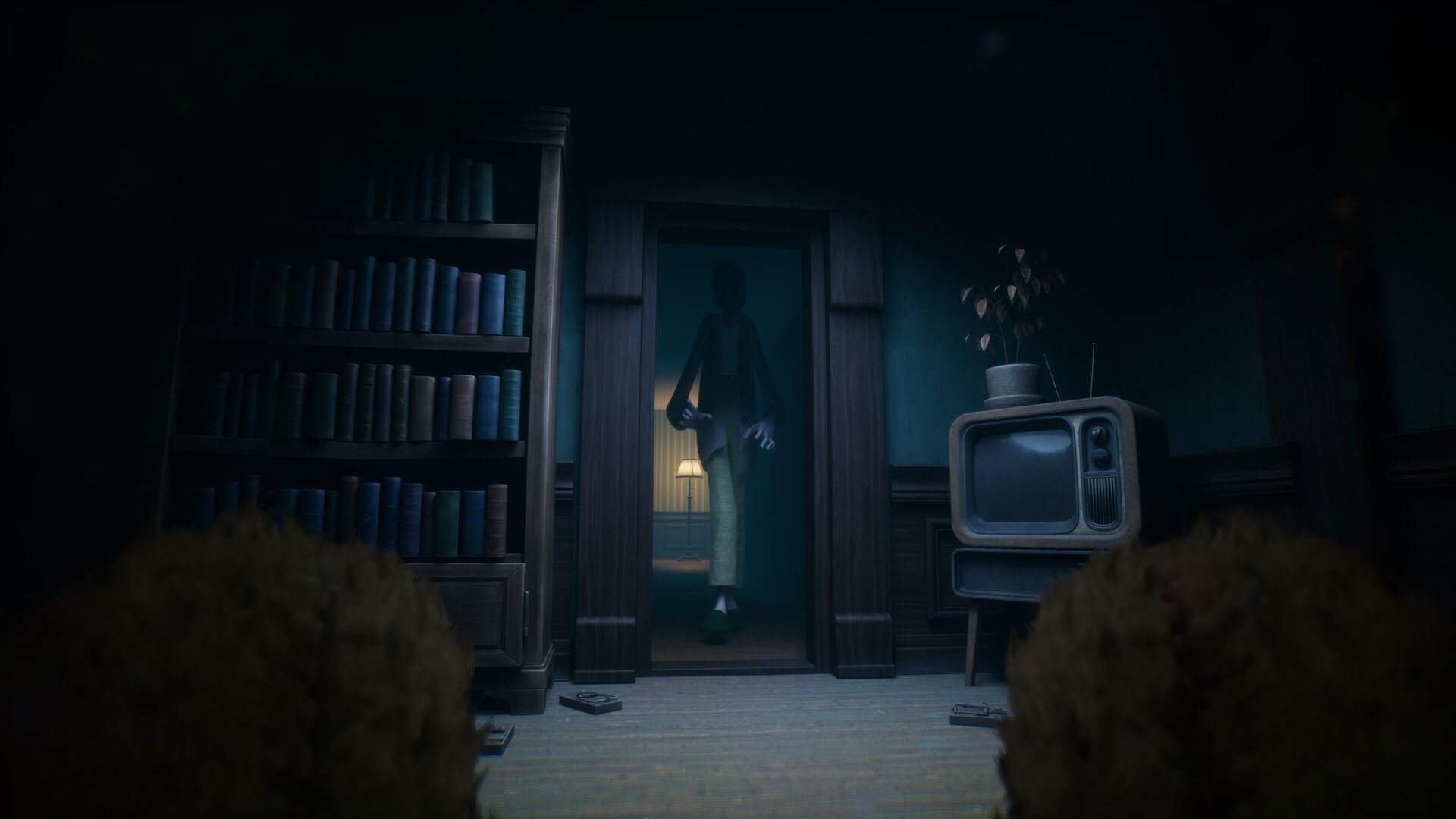
The adults pass through or patrol some rooms, requiring you to navigate them undetected. Crouching reduces noise, and hiding in the shadows also helps avoid detection. When solving puzzles, sometimes Sophie will need to make a sound, though, like pushing down a board to use as a ramp. Dangerous noises are indicated via a purple haze over Teddy’s vision, warning you to hide Sophie in case an adult is nearby. This purple haze also occurs when Teddy is being carried by Sophie while sneaking within the sightlines of the adults. When hunting Sophie, the adults’ gaze is amplified by a sinister purple light in place of their eyes, too. The brighter the light, the more aware they are of Sophie’s presence, meaning you need to reduce your noise or break line of sight in order to avoid getting caught. Once seen, capture is instantaneous, resulting in a restart from the most recent (generously placed) checkpoint.
It’s not quite Thief. You won’t be looking for different floor types to dampen the sound of your footsteps, but you will need to be cognizant of items and activities that make sound. While the early stealth segments are evocative of something like Clock Tower, merely about hiding, later sequences have you stealthily guiding Sophie alongside moving machinery to avoid being seen and heard, or distracting the adults with Teddy’s powers. Later still, there are noisemaker traps strewn throughout some corridors, like bells hanging from the ceiling, meant to alert the adults of any wandering children. Hitting one of these traps results in a reload, forcing players to slow down and navigate carefully.
The exception to instant capture when Sophie is spotted comes in the form of chase sequences. The first of these sees Sophie confronted by Clayton, one of the adults. He pops out from a room, scaring her, and she drops Teddy. Clayton picks Teddy up and begins chasing Sophie, mocking her little bear but unwittingly giving her a view of where to run. He soon becomes frustrated, not able to understand how the blind girl can see where to go, so his pace increases, jostling Teddy’s vision as he jogs. Eventually, Sophie gets away and Clayton drops Teddy. It’s a thrilling sequence, and an empowering one, as no one suspects the teddy bear. Later sequences have the ghosts pulling Teddy down a hallway, forcing Sophie to chase Teddy as she is stalked, while another has Sophie holding Teddy, using his psychic powers to unbar doors and clear their path. The rhythm between puzzle solving, stealth, and chase sequences is great and keeps urgency at the forefront, never knowing what the adults have planned next.
Less urgent are the hidden collectibles in the form of toys that belonged to the children who preceded Sophie – and perished – in the manor. These collectibles are often hidden in plain sight (well, Teddy’s sight), so it’s really just a matter of keeping your eyes open for them. They are entirely optional, however, and don’t give much in the way of story details, but they do provide some replayability for any you miss along the way.
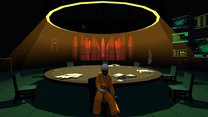
Throughout it all, Out of Sight features gorgeously designed visuals and a highly refined artistic style that is almost Burton-esque. The manor interiors, though initially a bit repetitive in their constructions, are highly immersive thanks to great lighting from lamps, glowing machinery control panels, and the full moon’s beams raining in from the windows. The texture detail is impressive too, with the basement dungeon lined with ancient brick walls and stone floors, while the upper floors are in a state of disrepair and disorganization, with holes in the walls, splintered furniture, and a gratuitous number of cobwebs.
The caricatured adult character models fit well into the horror setting, with the apple-shaped Clayton waddling through the hallways, while the ominous, long-necked Janna ducks beneath door frames to enter, stressing the already foreboding disparity in height between her and the little girl. Sophie also looks great, with her red blindfold and dress fabrics reacting to every move, creating a realistic, and dramatic, effect. Viewing the world from such a low perspective makes the experience all the more interesting and even mundane tasks a challenge, like how Sophie is too short to place keys in doors without the aid of a table or chair. If there is one criticism of the graphical fidelity, it’s that this same level of fabric and facial reaction detail hasn’t been applied to the adults as it has to Sophie. Her expressions are highly realistic, while the adults seemingly have a more wooden look. However, considering most interactions with Clayton and Janna have them partially obscured by darkness, it’s not always noticeable.
The voice acting all around is spectacular, with Phil Rowe and Vicki-Jo Eva giving life to the sinister stalkers in the house. Lily Turnbull does a convincing job of bringing young Sophie’s fear to life. The way the game smartly puts you in the role of the mute and helpless Teddy, while Sophie is technically doing most of the work and providing all the commentary, plays to its strength. There is a real bond between Sophie and Teddy by game’s end thanks to the actress’s convincing voice performance.
The game is scored with eerie string music, incorporating elements like xylophones to add a creepy, nursery-type effect. Some of the chase sequences feature a bolder, more intense score, but for the most part this is a quiet experience, focusing more on ambient effects than music.
Out of Sight can be played with either the keyboard and mouse or a controller, and while the game recommends the latter, I found it played fine with both. On the controller, the left stick moves Sophie’s legs and the right moves Teddy’s head. When Teddy has been placed down and Sophie has her arms free, she can hop up short distances (onto a cart or low shelf, for example) and perform actions like pushing, pulling, or picking up and using an item in the appropriate place, such as fastening a handle to an electronic lock mechanism. Sophie only holds one item at a time, but no puzzles require you to juggle multiple things. Sometimes when Teddy is set atop a pedestal and Sophie is performing an action like moving a wheeled cart, getting her to turn to the right way feels a bit awkward, but it’s never something you have to fight with for long. The game is also playable in VR, and I can see it working quite well with the mechanics in place, but since that version is still in early access (as a standalone product), I wasn’t able to try out this function.
Automatic saves are doled out fairly generously, making it easy to leave the game at any point and come back to it later. Most of the puzzle rooms are quite short, and for those that are on the longer side, checkpoints are provided in between steps. Apart from one instance, my time with Out of Sight was glitch-free. The only anomaly occurred when Sophie fell through the floor at one point, and her character model didn’t quite line up with the ground as she stood up. Even then, the game corrected itself rather quickly.
Final Verdict
Out of Sight is a powerful, endearing, and exciting horror puzzler. The bond built between Teddy and Sophie over the course of the game’s brief but highly compelling play time is incredibly touching, and I genuinely found myself unable to put the game down at points. Sophie’s handicap becomes her strength, and the smart way the game delivers both its story and challenges via the pair’s supernatural dynamic is wonderful to behold. It’s the type of narrative that could do well in another format, like a book or movie, but playing it as a game is what ultimately makes it so special. Though it may be a bit on the easy side for hardcore gamers, it constantly surprises with new challenges before ending on a bittersweet note, leaving room for a follow-up. Chances are that after you’re done playing, it’ll make you want to dig out that old teddy bear and give it a squeeze.
Hot take
Out of Sight is a brilliant, and at times touching, take on classic survival horror, mixing stealth, environmental puzzling, and even the occasional chase sequence into its thrilling escape mission. It’s short and maybe a bit on the easy side, but the excellent pacing and terrific storytelling will keep players gripping their teddy bears with delight.
Pros
- Incredible voice performances convey all the right emotions
- Great mix of stealth, puzzle solving, and a little bit of action
- Moody, atmospheric environments elegantly shown through the eyes of a child (well, teddy bear)
- Great storytelling keeps the mystery thick
- Puzzle variety keeps the challenge fresh
Cons
- Adult character models aren’t as refined as the protagonist’s
- Controls when moving some objects can be tricky
Drew played Out of Sight on PC using a review code provided by the game's publisher.


0 Comments
Want to join the discussion? Leave a comment as guest, sign in or register in our forums.
Leave a comment